
Image: Sergey Ivanov, 2020
It may have been in that golden 1941 that one
young American, who then would have been twenty years old, might have stood
outside the gates of one of those summer pavilions and danced with his friends
to the big band sound of the Benny Goodman Orchestra--Sing, Sing, Sing, maybe, or Stompin
at the Savoy, or One O’Clock Jump.
The sound of which, he would say many years later, would “blow your ears back.”
To be twenty
years old is a kind of golden age of its own, suffused with the promise of something
momentous in the offing. Out beyond the country’s horizons, dark clouds were
forming over Europe; the 20-year old could not have been wholly oblivious. He
had at an early age already experienced loss, had already learned the stark
lesson that the world you think you know is not permanent. But on that night, I
like to imagine that he was (along, perhaps, with the rest of an America
closing its eyes to the forbidding horizon) having fun; for now, that would be
all that mattered. Whether he’d taught himself or taken lessons I don’t know,
but the man knew how to swing dance, the Lindy Hop, or the Collegiate Shag, the
Jitterbug, or the Lindy Charleston.
Every story is,
in a sense, a conjuring up of a golden age. Let
me tell you how it was, back in the day. But the real truth about anyone’s
Golden Age, what really happened beneath
the scrim that is memory, is liable to be more ambiguous than you or I would
wish. The story of the twenty-year old dancing with his friends to the Goodman
Orchestra, of what preceded and what followed, is illuminative. It was a life that made a forcible impression on my own. And yet I have to confess there
is a lot I have to fill in from scratch or imagination. I only dimly recall him
telling me about attending a concert by Goodman’s band, and I don’t know for certain
if it was really 1941, or earlier when he was in high school. I don’t know if
it was in the nation’s capital, where his family had moved in 1933, or in New
York city where he might have travelled for Goodman’s storied concert at the Paramount
Theater, or somewhere else.
How little we know
about the most exalted moments in the lives of the people who matter most to
us. Goodman’s obituary in The New York Times in 1986 described the euphoria
among fans of the bandleader, who in 1935 became the King of Swing when his
band performed an explosive concert at the Palomar Ballroom in Los Angeles. The
stunning roar of that crowd in Hollywood would follow the band throughout the swing
era, which lasted into the 1940s. And it greeted the band in March 1937 in New
York at what came to be known as the Paramount Theater riot.
“Teenagers,
who had followed the band on radio and had bought its records but could not
afford the prices of such places as the Manhattan Room of the Hotel Pennsylvania,
where the band usually played, were lined up around the theater at 6 A.M. to
get into the morning show for 35 cents. During that day, more than 21,000
people jammed into the theater to bounce deliriously in the seats or shag in
the aisles and battle ushers as they made desperate lunges toward the stage.”
Wherever he might
have heard the Goodman band, at whatever theater or moth-lit summer pavilion, I
like to imagine, as the Orchestra reaches a crescendo of delirium, the young
man and his friends scaling the gates or storming the guarded doors, just like
any contemporary music-loving concertgoers. And as a kind of retroactive act of
gratitude for the prudent, cautious and retiring example he set for me, I like
to envision the young man, my father, Robert Thomas (Bud) Moran, ascending the
barrier or breaching the boundary, and then
at the very apex of his personal Golden Age, triumphantly tumbling over or
tumbling in, and crashing the joint.
Here is his
American story.
_____________

“It’s hard for you to understand what
it’s like to be 13 and to lose everything.”
All his years
later he might have recalled the brilliance of the lake down below, would
recall its azure surface as sheer as onion skin, the sailboats lazy in a summer
lull, and the billowed blanket of small green and brown hills around it. Might
have recalled it as a vista spread expressly for a child’s imagination, just
for him, there up above the sailboats on the big wrap-around porch, lounging in
the hammocks with his brothers and sisters. Good or ill, benevolent or
otherwise, the world is received by a child as an intention: this is meant
for me.
It might have
gathered all the sunlight to itself after it was gone, casting a shadow on all
his remaining years after, the memory of that childhood with the big old
cottage in Skaneateles overlooking the lake, where the family would retreat
from Syracuse in the summer. The earliest picture of Bud is of an uncommonly
sweet and trusting boy. His father, my grandfather, might have been imposing,
intimidating, or he might have been the kind of presence that inspired a sense
of safety and assurance. I knew him only briefly before his death in 1965, when
I was five, knew him only as an old man with a cane and a penchant for giving
overly wet kisses. His obituary in the Washington Post, beneath a headline that
read, “John F. Moran Dead, Aid in Depression,” showed him as he was in his
prime during that period in the 30s, after the move to Washington, when he was
a federal receiver for local banks that had failed after the crash; a
photograph that suggested a man whose tombstone might have read: Very
Substantial Banker.
Tax records in
the town of Skaneateles from 1932 indicate a lakefront home, listed as a
“cottage,” was owned by John F. Moran with a total assessed value of $5500.[1]
For years through the 1960s and 70s, a pen and ink drawing of the cottage hung
in the “recreation room” of our house where I grew up. The drawing suggested a
lost life of carefree ease, an impression confirmed by the account left by my
father’s brother Richard. My uncle Dick wrote a lively and informative memoir
of his own life, published in book form by Richard’s wife for their children,
that includes a richly detailed description of the family’s life in Syracuse
and their summers at Skaneateles.
“Every June, the day after school
ended, the family loaded up the car and drove twenty miles to Willow Brook on
Skaneateles Lake. This annual odyssey began in 1926 and ended in 1931. The
cottage had four bedrooms, a sun porch added by John Moran in 1928, a garage
near East Lake Road with a small bedroom for a chauffeur or servant, a bridge
over the brook to a grove of large willow trees on the water. Peonies lined the
driveway; a small formal garden was in back of the house, a rose trellis at the
side door. The brook was about two feet deep maximum. It offered great
opportunities for play with toy boats, crabbing and spearing suckers the came
into it in early summer to spawn.” [2]
To be sure, it
was an idyllic period of leisure and fun—anyone’s happy childhood, however
mythical. That my grandfather was successful and prosperous is certain and John
F. appears to have possessed the determination to rise, to overcome, that is
common to the children of immigrants. He was born in Syracuse in 1889. His
mother Alice was born in Ireland and likely immigrated to the United States
between 1863 and 1883; his father (my father’s grandfather, John J. Moran) was
born in New York, but almost certainly to recently arrived immigrants. The
father appears to have died or otherwise departed the picture around 1898, and
the children were briefly in an orphanage; John F. was in the House of
Providence, a boy’s orphanage, while his sisters were in St. Vincent’s Asylum
for girls. Their mother Alice remarried, and by 1910 census records indicate
John F. and the other children were living with their mother and stepfather.[3]
John F. began
working as a bookkeeper in the Crouse Grocery Story, in Syracuse, then as a
teller for City Bank. In September 1913, he married Kathryn Handrahan (my
grandmother). He rose steadily through the ranks of City Bank to become a
member of the board of directors. Robert (Bud), my father, was born in May of
1921.
In late 1929, after the Wall Street
Crash, City Bank Trust merged with First Trust to become the largest commercial
bank between New York and Buffalo. At that time, John and his wife
Kathryn and children were living on Bellevue Avenue in Syracuse. By 1932, he was a deputy superintendent of
banks for the state of New York.2
What happened
exactly to my grandfather’s fortunes is unknown. Dick’s autobiography records
only that John sold the cottage in Skaneateles in 1932 as the depression was
deepening. Sometime after Roosevelt’s election that year, my grandfather took a
job in Washington, D.C., within the office of the comptroller in the department
of justice—a job that spoke to his resourcefulness and to his connections
within the banking world, but which was also invariably a steep step down in
salary for the banker and in “lifestyle” (a term that was probably unheard of
at the time) for the family.
It’s difficult
for you to know what it’s like to be 13 and to lose everything. I might have been 13 myself—that passage of
rawness and awkward discovery coupled with an exhilarating sense of one’s
purchase on the world—when my father said this to me. Whether my grandfather really lost everything
or whether it was simply my father’s recollection of a dramatic and
disorienting shift in his own life and the life of the family, is hard to know.
My father’s remark was in any case a singularly dramatic comment by a man never
given to drama, reflecting the shock of his impression, one that would never
quite leave him, that the ground beneath our feet is never certain.
My grandfather
took the job sometime in early 1933 and was acting as a receiver for several
failed local banks that year; the family appears to have stayed behind in
Syracuse for a period before moving in October 1934 to Virginia where,
according to Richard’s autobiography, the family moved into a “large frame
house overlooking the Potomac River, the city of Washington and Boeing Field,
which later was expanded to become National Airport.” Their sojourn there
lasted only two months and in December they moved to Bethesda into “a pleasant
two-story brick house on a quiet street in a subdivision known as Battery
Park.” In the summer of 1936, according
to my uncle, they would move yet again to a home in the 7000 block of Connecticut
Avenue. My father’s parents must have been renters during these early years,
for their names do not show up in property records as homeowners until 1940. [4]
And so my father and his family arrived in the
nation’s capital and would become Washingtonians.
_____________

My father was a
student at BCC High School, which opened in its current location on East-West
Highway in Bethesda in 1935 (the school had existed since 1926 as a two-room
building on Wilson Lane). My uncle’s autobiography mentions a young man who had
his own car and drove Dick and my father (and perhaps whoever else could pile
in) to school, a young man who would become a lifelong friend of my father’s. This
boy with the car—that American invention of freedom and mobility—must have been
the talk of the campus.
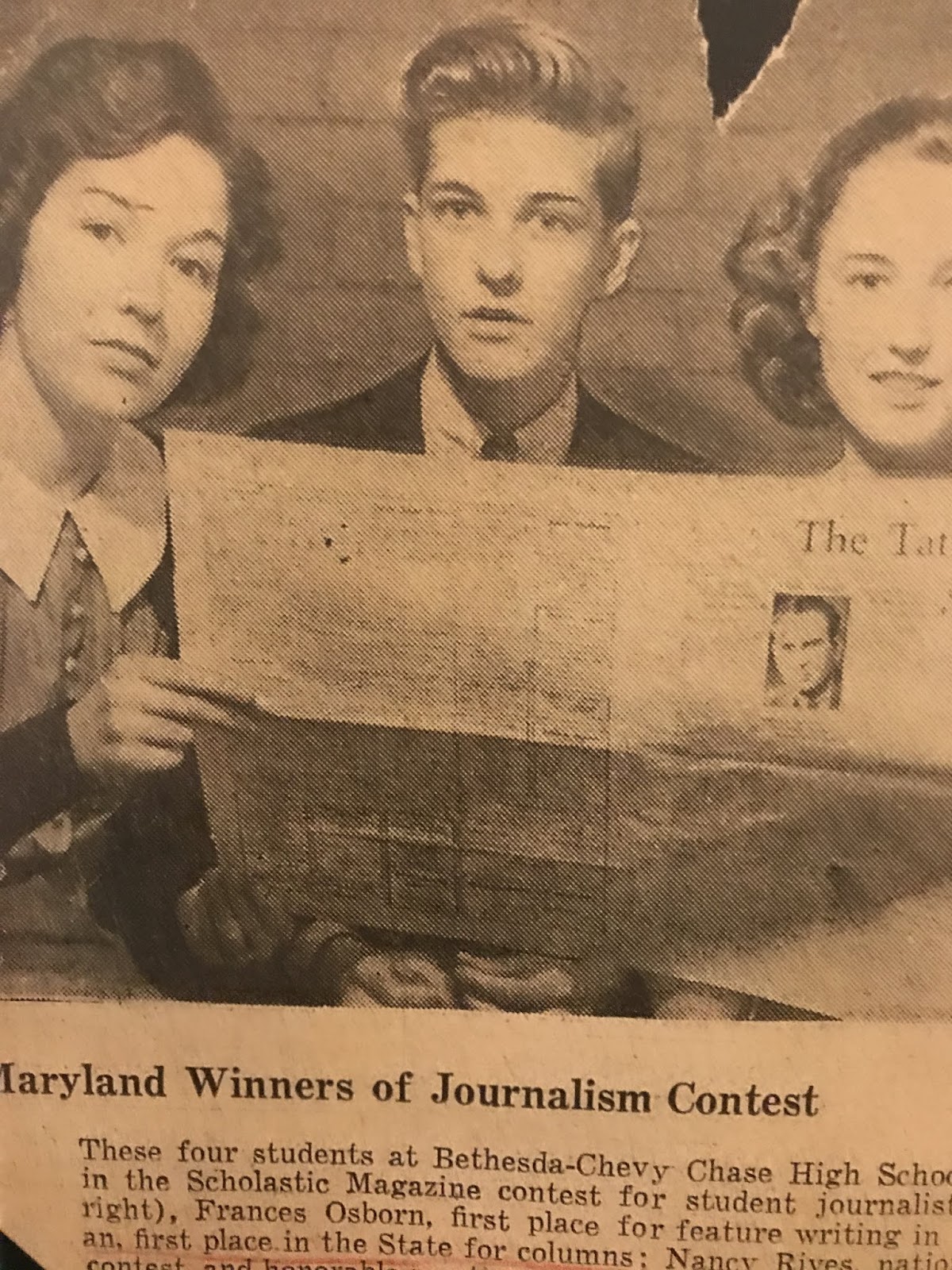 |
| My father. From the Washington Post, circa 1935 |
My father wrote
for the high school newspaper and was photographed in the Washington Post
having won an award for “columns.” It shows a handsome if still callow looking
youth, immaculately well-groomed in the jacket and tie that students were
expected to wear—a presentation that was the hallmark of the era that shaped my
father and for which I believe he would always be nostalgic. My father was popular
and a partier, and it was in this period when he came to love Benny Goodman and
the big bands, swing dancing, Fred Astair and Ginger Rodgers. It was the advent
of the entertainment era, of “movie stars” and “show biz.” Years later my
father’s voluminous album collection would serve as background music to the
Sunday afternoons of my childhood when my parents would relax (with cocktails
and cigarettes) in the living room—Goodman, Louis Armstrong, Sinatra, Ella
Fitzgerald. And mid-century Broadway musicals—Carnival, The King and I, Camelot,
Hello Dolly. I am unsure what happened to his album collection; in later years
he acquired a small collection of CDs, a portion of which fell to me after his
death, and I was slightly surprised to find Billie Holiday among his favorites.
Another, darker
strain was also a feature of my father’s adolescence. His younger sister Alice
had osteomyelitis, a crippling and painful infection of the bones. Penicillin,
discovered in 1928, did not become widely available until after the World War
so I am unsure how her condition was treated. Alice was bedridden for a period
and I believe I recall my father saying there was a time when she was unable to
attend school. He spoke with feeling about her plight which, like the family’s
upheaval from their idyll in Syracuse, may have ingrained in him an awareness
that in the blueprint of our universe, fairness is given no quarter; he
entertained her during her bedridden years reading society news about the stars
and starlets of the period. But Alice was feisty and would grow up to become a
journalist for Time Magazine. (She wrote the cover story in 1949 for the
magazine about Perle Mesta, a Washington socialite and pioneering feminist who
had been appointed by President Truman to be ambassador to Luxembourg).
Remarkably, in the early 1960s the magazine purged its staff of women,
providing my Aunt Alice with an extremely generous compensation on which she
retired. (Her husband, Al Goldsmith, covered Capitol Hill for a newsletter he
published for the insurance industry.) Alice was a voracious reader and spent
her long early retirement consuming books, especially political biographies.
When we visited her house, she would have a waist-high stack of books by the
sofa she was working her way through. She was a staunch and vocal New Deal
Democrat all her life. My father enjoyed baiting her, and one summer night
arguing outside on the porch of our house, after a few drinks, Alice became so
loud and overheated that my parents became alarmed that she was disturbing the
neighbors.
One other event
during this period of my father’s adolescence would make its mark on him, I
believe, when his father became a central player (and I believe a hero) in a
local bank scandal.
The Park Savings
Bank was located at the intersection of Kenyon Street and 14th
Street in Mt. Pleasant. It had been opened in 1909, by residents and
businessmen of the neighborhood who wanted a regional bank. It closed in March
1933 with liabilities of nearly $4 million. After the Bank Holiday that year, Park
Savings did not re-open but fell into federal receivership. On July 17, 1934
the front page of the Washington Post reported that 28 directors of the bank
were being sued “by John F. Moran, receiver, in District Supreme Court
yesterday in an effort to recoup the huge losses suffered by the bank.”
Charging the directors with ten acts
which involved “nonperformance of, malfeasance in the performance of, and the
malfeasance of duties imposed by law,” the action listed liabilities of
$2,595,991.60 which it alleged were traceable to the directors.
This report
appeared on the same day that troops from the National Guard and tanks were
sent into the city of San Francisco to quell riots that occurred in the wake of
a general strike. Also reported by the Post that day was unrest at a University
in Germany by students protesting the Nazi closure of student fraternity
organizations; that article also noted that the national leader of a German
Catholic youth organization was killed, and “a new attack on Jews was
inaugurated by Der Angriff, newspaper of Propaganda Minister Joseph Goebbels.”
In November 1933,
seven months before the suit my grandfather filed in court against the bank
directors, there had been a move in court by a group of depositors to have my
grandfather replaced, presumably by a locally-appointed receiver. Newspaper
reports about this episode are not clarifying; it may have represented a
difference of opinion about how to proceed in recovering depositors’ money, or
it may have been a reflexive distrust of the federal government to act in the
best interests of depositors. The suit
by the depositors’ group was dismissed and for the remainder of the 1930s my
grandfather proceeded to act in the role of undertaker for the bank and to
strive to retrieve depositors’ money.
The scandal
appears to have involved a principal actor, a director of the bank named Robert
Stunz, and a handful individuals to whom, over a period of years, Stunz made
loans with no collateral, using depositors’ money. Somewhere in between the
lines of the Post reports there is, I believe, a story about what kind of
leverage these individuals may have had over Robert Stunz; the reports are intriguing
but raise more questions than they answer. In addition to the wildcat loans,
several reports cite “hard liquor supplies” that Stunz purchased with
depositors’ money. Shortly after the bank holiday in March 1933, the Post
reported that Stunz died by suicide, leaving behind a note accepting blame for
the bank’s failure and absolving all other employees of any wrongdoing.
My grandfather’s
obituary in 1965 cited four other local failed banks that fell under his
receivership. Some 9000 banks failed during the decade of the 1930s, more than
4000 in 1933 alone. The facts surrounding the Park Savings Bank scandal, as
well as the attention the local press gave to it, suggest a criminal escapade, something
that rose above the standard story of depression era failure; a report in the
Post on May 7, 1937, offering one of the clearest summaries of what happened,
refers to what auditors and investigators were calling “a conspiracy to
embezzle.” Still, the machinations of the bank directors could only have
happened in a time when banks were unregulated to a degree that is unimaginable
today. Although my grandfather’s part in this saga unfolded during the decade
of my father’s adolescence, when the drama of his own life commanded his
attention, it can hardly have escaped my father’s notice when his father’s name
was appearing occasionally on the front page of the local paper.
On October 20,
1939, a month and half after Hitler’s Germany invaded Poland, the Washington
Post reported that the United States Senate was debating lifting an arms
embargo to European allies. That story shared the front page that day with the
following account that appeared to mark the end of the Park Savings Bank saga:
By that time my
father was 18. He would go to the University of Maryland and after graduation,
after Pearl Harbor, would enlist in the army. He would be swept up in the
immense events that were to come, World War and Cold War.
But my father
was, first, a Depression-era child, and the events of that period, including his
father’s role, occurred at the stage of his life when one is possibly most
receptive to the imprint of the larger world. In these two events—the family’s upheaval and my
grandfather’s role in securing the depositors’ money—were illuminated the
central themes that formed the lived experience of an entire generation that
came of age in the Roosevelt years, the men and women who would fight the world
war and later forge the post-war American consensus: the ground beneath your
feet might be ever uncertain (you have no idea what it’s like to be 13 and
to lose everything), yet the government could use its power to secure the
ground, at least minimally, freeing you to flourish as you might. In its best
light, the New Deal was in the service of that high American ideal of freedom;
you could not ever be truly free if you were forever at the mercy of calamitous
circumstance.
Not everyone
bought this, to say the least. There was most certainly a vigorous opposition
to Roosevelt and to his plain-speaking successor from Missouri. (David
McCullough’s epic biography of Truman is consoling, if you need reassurance
that poisonous character assassination in American politics is nothing new). My
father was a lifelong registered Democrat, and I believe the New Deal was for
him formative. But he was by no means an enthusiast, and he was all his life
ambivalent, at best, about politicians in general—all of them. (I do not recall
him expressing great enthusiasm for any politician with the possible exception,
briefly, of Henry Jackson.) In later years, the tumult of American life in the 1960s,
would push him rightward. But his family’s experience, his father’s role in the
Depression, and his sister’s infirmity, fostered an acute awareness of, and a
genuine fellow-feeling for, the regular guy or gal and his or her vulnerability
to wanton and outrageous fortune.
____________
My father’s
sojourn at the University of Maryland was unremarkable; he majored in
accounting and joined the Phi Delta Theta fraternity, in whose house he may
have lived during his upper-class years. He graduated in 1942.
Life changed for
everyone that year in December, and sometime after the attack on Pearl Harbor
my father enlisted in the Army. He would be stationed at Ft. Hood in Killeen,
Texas.
 |
| In the Army |
Of his time in
the Army my father was memorably sardonic. It was, he said, where he learned a
sense of humor. The truth, I think, was that he already had one, and it was
what helped him survive apprenticeship in a life—the life of a soldier—for
which he did not bring a natural talent. I think he must have appreciated
Joseph Heller’s classic account of the absurdity of military life in Catch-22;
it was a place, he once memorably told me, where you might be told to go dig a
ditch and then ten minutes later be told to fill it back up. You meet the world
when you go in the Army, and my father recalled being platooned with guys from
all over, guys who grew up in the sticks in Tennessee or Arkansas, guys who
couldn’t read or write. My father was sometimes enlisted to write letters home
to parents, wives or girlfriends. “Dear Mom, miss you terribly. Food’s horrible,
but I’m ok. Try not to worry. Love, Joe.” Something like that. He was
discharged in 1946 as a second lieutenant, never having been sent overseas.
One of my
father’s best, lifelong friends did see combat. He received a medal for taking
out a bunker full of German machine gunners, this friend of his, tossing a hand
grenade into the bunker and killing them all. My father said his friend never
spoke about this episode and did not want to. His friend confided to him only
that it wasn’t heroism, he was terrified. Many years later, with advanced
emphysema, this man—the boy in high school at BCC who had his own car, the talk
of the campus—would die by suicide, a casualty of alcoholism and depression.
Shortly after his
return home to the D.C area, my father would meet my mother—six years his
junior—then a student at the University of Maryland and a roommate of my
father’s sister Mary. My mother, Ellie, was a fun and lively young woman, a bit
of a party girl perhaps, but with cultural and intellectual aspirations as well
that she instilled in me and my brothers. She had grown up in Baltimore. She
had a knack for friendship and was instantly liked by everyone; the fast group
of women friends she made in the Kappa Kappa Gamma sorority—and later with their
husbands—would prove the nucleus of my parents’ social lives. Over six decades
from the 1950s to the early 2000s, they shared the arrival of children, many University
of Maryland Terrapin athletic events, vacations together with all of our
families at the eastern shore, the decline and passing of their own parents, as
well as a tragedy or two along the way. All of these passages were punctuated
by countless high-spirited cocktail parties; these men and women were a sturdy
bond of fun and music, camaraderie and celebration that nourished both my
parents to the end of their days.
My father and
mother were married in 1953. They settled first in the Glover Park neighborhood
of the district. My father had a job as a bookkeeper for a local radio station;
later he would become the accountant for Barry Pate Chevrolet, a family owned
car dealership located at 1129
Connecticut Avenue, with which my father would be associated, through
location and name changes, until his retirement. (At some point in the early or
mid-1960s, the dealership merged with Addison Chevrolet and the new Barry Pate
and Addison would be located—somewhat fatefully, given late events that would
transpire—at Florida and 14th Street.) My father was remarkably
reliable; over many years I can count on one hand the number of times he stayed
home sick, and he was awake at the breakfast table every day at 6:20 a.m.
To live for long
in this most self-important city is to begin to see your life against the
backdrop of national and international events. Looking back at the frontpage
headlines at the time of my and brothers’ birthdays, two themes are consistent:
the emerging and burgeoning civil rights movement here at home, and the
confrontation with the Soviet Union. On May 4, 1954 when Michael, my oldest
brother, was born, Post reporter Chalmers Roberts topped the front-page
headlines that day with a report about the collapsing French adventure in a
far-off region few Americans probably gave any thought to—Vietnam. A conference
in Geneva was being worked out to “take up the Indochina problem”; the
agreement at this conference would divide the country, with fateful results, into
a north (supported by the Soviets and the Chinese) and a south supported by the
U.S. Just above the fold, Murrey Marder reported that Democrats and Republicans
were tussling over the scope of the Army-McCarthy hearings, a sordid televised
drama of accusations and counter-accusations, an off-shoot of McCarthy’s red
scare investigations; it was during the Army hearing that the Senator would be called out—“have you no
shame, sir?”—beginning the end of his prominence. Thirteen days later the U.S. Supreme Court would rule in Brown
v. Education that public school segregation was unconstitutional.
Michael recalls our father taking him, in
November 1963, to the showroom of the dealership on Connecticut to watch the
funeral motorcade following President Kennedy’s murder in Dallas on its way to
St. Matthew’s Cathedral on Rhode Island Avenue. Nine years old at the time, Michael
remembers seeing the President’s stricken wife, his brothers, French president
Charles De Gaulle, and Ethiopian Emperor Haile Sallesie.
In the December
of the following year, when Robert, my next older brother, was born, the
Montgomery bus boycott would begin in Alabama. Earlier that year, the Pentagon
announced a decision to build inter-continental ballistic missiles armed with
nuclear warheads; Congress authorized President Eisenhower to use force to
protect the island of Formosa against the People’s Republic of China; and the
Soviet Union and seven eastern bloc countries signed the Warsaw Pact. On my
birthday on St. Patrick’s Day in 1960, rain was turning an eight inch snow
storm into the characteristic DC slush festival; that headline shared the front page with a story about West German
chancellor Konrad Adenaur who was calling for a plebiscite in West Berlin to
“demonstrate that its citizens `absolutely reject’ Soviet demands on their city,” and an article about plans to
test a 10,000 pound bomb underground in New Mexico. (Slightly lower on the page
was the headline: “Ike Comes Out Publicly for Nixon.” Seems even President
Eisenhower was a tad ambivalent about the vice president, a man who would
dominate the news for much of my later childhood and adolescence, a man described
memorably by the novelist Thomas Mallon as “this darkest of dark horses.”)
To the privileged
children of a prosperous kingdom, news of trouble in the kingdom reaches their
ears as through a scrim; it sounds bad, but what could it mean? The year 1968
was so brimming over with bad news even an eight-year-old couldn’t miss it. I
occasionally helped my brother deliver the Washington Star in my
neighborhood in the afternoon and can still recall the shock of that picture of
Robert Kennedy lying on the kitchen floor of that hotel in Los Angeles. I had
never heard the name Martin Luther King before April 4 of that year; in the
aftermath of his murder in Memphis, the District of Columbia experienced the
most searing episode in the city’s history, when rioting ravaged large sections
in and surrounding the U Street corridor, all the way up to Capitol Hill and in
other discrete areas throughout the city. A car was set afire on a lot at
Belmont and 14th, the lot belonging to the dealership my father
worked for, whose store front was a block south at Florida and 14th.
The Evening Star reported broken windows at the dealership, which remained closed
during the riot. I recall my father journeying downtown while it was still
raging to check on the state of affairs; for whatever reason—perhaps because the
business had established a reasonably good relationship with the surrounding
community, perhaps because black men and women were employed there—it was
spared the kind of comprehensive damage that destroyed other businesses in the
area. It would re-open and remain in business for a lean years in the now
ravaged neighborhood before relocating. Later that summer I recall attending a
Washington Senators baseball game at D.C. stadium with my family when National
Guardsmen patrolled the bleachers.
It wasn’t all bad
news. My father was an early joining member of the Edgemoor Club in Bethesda, a
tennis club that had opened in 1920. A prettier picture you can hardly imagine:
a private club “nestled” in a leafy green and well-to-do suburb; its clay
courts are expertly manicured and for years has enjoyed a reputation for
training some of the top tennis players in the region (including Davis Cup
competitors) and for hosting elite competitions.
In fact, it
always seemed to me like a pretty friendly and casual place, untouched by country-club
stuffiness. But Edgemoor was really my father’s thing; he joined in the 1940s
when he returned from the Army. My brothers and I used the pool quite a bit,
but tennis never really took with any of us in a big way. For years, my father
regularly played two sets of tennis on Sunday morning with a leading staff
member for the Senate Foreign Relations Committee, chaired at that time by
William Fulbright. (Our mother took us to Methodist church while he played; my
father had been raised with an especially dark and forbidding version of Irish
Catholicism and as soon as he was of age, he left the Catholic Church—an
institution about which he had nothing good to say—and never again
darkened the door of a church.)
In 1968 he was
president of the club, when the issue of race visited its cozy confines. On
November 3, of that year, a report in the Post on page 3 of the A section of
the paper was headlined: “Edgemoor Won’t Play `Whites Only’ Tennis.”
The Edgemoor Club of Bethesda, long regarded
as the citadel of Washington area tennis, has decided not to participate in
competitions with clubs that refuse to allow Negroes to play. The decision was made by a “decisive majority”
of the club’s 300 members at a meeting Tuesday, according to Robert T. Moran,
club president. At the same time members also urged the Greater Washington
Tennis Association, the Middle Atlantic Lawn Tennis Association and Country
Club Amateur Swimming Association to adopt similar stances.
My father was
quoted in the article saying Edgemoor “wanted to go on record as disapproving
of clubs that were arbitrarily not hosting matches because of the presence of
Negroes on visiting teams.” He declined in the article to name those other
institutions, but the Post report did. It also noted that the wife of Carl
Rowan, then a prominent black columnist with the Evening Star (and later the
Post), had joined the Indian Spring Country Club, after which some other area
establishments dropped out of the league in which she would have played. (The
article said the clubs denied that Mrs. Rowan’s race was the reason for their
departure).
Against the
larger backdrop of what was happening in the country around race at that time,
and of the history of the civil rights movement since its origins in the
aftermath of the world war, this declaration by a private suburban enclave was
assuredly no revolutionary moment (the article noted that the Edgemoor Club
itself had no black members at the time. “There would be nothing preventing a
Negro becoming a member should he apply,” my father was quoted in the Post as
saying.) But within its own rarified sphere it was influential—the club was
described by the Post as the “Forest Hills of Washington tennis”—and I do not
doubt my father’s wholehearted support for this position. He was the farthest
thing from any kind of activist or social justice warrior, but I think he knew
stupid when he saw it. Whatever else the segregationist policies of that era
might have been—immoral, unethical, unjust, untrue to our values, and damaging
to generations of black people and their families—they were also surpassingly
stupid. And the club’s declaration spoke to the momentum of a movement,
seven months after the murder of its leader, that was no longer confined to the
southern regions of the country.
What my father
was (and everything in this narrative stands or falls on this declaration) was decent,
a characteristic that has lost ground, at least in the public sphere, to
flashier traits. His background made him alive to the petty injustices visited
upon everyday people. Closely allied with integrity, decency speaks to a private
accountability, a holding of oneself to a standard. The striking thing about
decency is that in the everyday lives of everyday people—on the ground, so to
speak, where all of the cultural divisions are dissolved in the sober light of
prosaic reality—it is everywhere. People like to be decent. In the
public sphere—in public office, in public pronouncements, in social media and
on cable news shows, and in the online comments
section of articles and opinion pieces—no one is accountable to anything at all, a plague of public indecency.
____________
The following
year in 1969 saw an event that had its genesis in the Cold War confrontation
and the arms race, but which in its
culmination transcended the Cold War and became—in the minds of many, and in
popular legend—a landmark of American technological wizardry, and human
ingenuity and courage.
 |
My family at a Fenwick Island cottage we
rented, circa 1965.
|
 |
The young folks on the beach at Fenwick Island,
circa 1968-70. |
That day of the
moon landing we played football on the beach with the children of my parents’
friends, a dozen or so teenagers and a handful of us younger ones. I was nine,
a childhood friend from school had joined me and my family for the vacation. I
recall looking up from the game and marveling at the moon, already risen in a
daytime sky: three men were up there, in a little craft, two of whom would get
out and walk around on its surface. It was dreamlike and magical, but then you
looked back down and saw your own feet were planted on the earth and your own
reality—whatever it was—all around you: a crystal blue ocean, its tide coming in
and going out as it had done since the beginning of time, the hot sand, friends
and family, a football game, and over the dunes the ramshackle cottages. It
made you a little giddy to think of it this way: we had made the leap from down
here to up there.
That night our
three families—parents, children and their invited friends, assorted others that
came together for the event—gathered at the rented cottage of one of our
parents’ friends around a staticky black and white television. Larger than the
one my father had bought, the house was of the same vintage, one of the oldest
standing structures in Fenwick, and it stood just feet from the dunes that
separated it from the beach, so that you could hear the waves cascading against
the shore a hundred yards away in the darkness. The exit by the astronauts from
the lunar module seemed to be delayed interminably; reception on the tiny
television was tenuous (when, say, the
wind blew), and I fell asleep on the floor to what seemed like a blur of
static and commentary. Someone shook me awake just in time to see Neil Armstrong
step off the ladder and onto the moon.
I think sometimes
of that summer of the moonshot, when I gazed up from the sand at the moon in a
crystal blue sky, as the apex and the end of something. Americans today are
nostalgic for a “golden age” and—political slogans aside—almost everyone in this
strange and troubled time feels that we have left something behind along the
way, that we are off our game. If I could point to a golden age of my own, I
guess that summer would be mine. I grieve now for the loss of what feels like
an American normal my daughter, now in her twenties, will never know; a country
that collectively did great, unimaginable things, that conquered the moon. (It
is astounding, for instance, to recall that the moon shot was pulled off using
computer systems that would be considered antiquated in any office setting
today.)
But I know it
must have been only my innocence that was coming to an end, the kind of bubble
that is for lucky children to experience. Outside the picture frame of my
memories there was, of course, an enormous amount of trouble in that
year 1969, although I was only dimly aware of it. (There is, too, an
alternative narrative about the moon shot, one that many Americans held to then
and might ascribe to now, a story of extravagant sums of money wasted on a
technological venture that bore little real tangible benefit for citizens, a
lavish expenditure while our inner-city communities were in turmoil and our cities were in flames.)
I am aware that
my narrative describes an impossibly privileged childhood—a private tennis
club, a cottage at the beach—and I know that in real terms I was extraordinarily
fortunate. All I can tell you though is that it didn’t feel like privilege. My brothers
and I attended public school from kindergarten through high school. We did not take vacations in Europe, but drove three hours to the shore, where
extravagance was a trip to the boardwalk in Ocean City and ice cream at the
Dairy Queen. (We also drove 6 hours the other way, in summers or at Christmas, to
rural Ohio to visit my mother’s parents, a journey that always seemed to me an
exotic and magical trip to the edge of civilization.) When we went as a
family to baseball games we sat in the bleachers. My mother bought my clothes
each new school year at discount department stores. The life of my childhood
and that of my friends seemed to be a life that was available to every
American. Who could blame me for thinking the world, like the Skaneateles of my
father’s youth, was a given? I was safe, protected by a kindliness that seemed
to pervade everything in a benevolent and fair-minded country that (I was
taught to believe) allowed the strong and gifted to flourish while striving to
protect the weak and vulnerable. Over the dunes, those modest, ramshackle
cottages seemed accessible to just about anyone.
They are gone
now, almost all of them, replaced by multimillion-dollar winterized mansions.
As my adolescence
progressed, I entered that long, self-absorbed tunnel through which you can
only see your parents as tedious, simpleminded and embarrassing. The most minor
foible becomes an indictment of their entire way of being; my father sometimes
wore so much aftershave it knocked you sideways; we had to tell him to dial it
back. I was not above thinking my father should have been something more than
he was, accomplished more than he did.
Many years later,
when I was myself a father, a friend introduced me to Robert Hayden’s
dagger-to-the-heart retrospective on fatherly devotion and adolescent scorn.
“No one ever
thanked him,” the poet says
of the man who “got up early/and put his clothes on in the blueblack
cold/then with cracked hands that ached/from weather in the weekday weather
made/banked fires blaze.”
Too late, the poet is the wiser now.
“Speaking indifferently to him
Who had driven out the cold and polished my
good shoes as well,
What did I know, What did I know
Of love’s austere and lonely offices?” [4]
What did I know?
That same summer,
or perhaps the next, an August night in Washington, the air is torpid and wet
with humidity. Summer has dragged on too long, greenery everywhere is limpid,
given up, exhausted by the heat, sagging into the streets. The night is close.
There’s a party of some kind at the Edgemoor Club and a large crowd is
assembled in the clubhouse that separates the pool from the tennis courts. I am
here tonight with my mother and my older brother and there is an air of
anticipation, although for what I can’t yet know. My mother knows for sure and
seems to let on that it will be fun, but she isn’t saying. My brother may have
known as well, though he would be as astonished as I was at what was to
transpire.
A space is
cleared and the assembled crowd falls back to line the walls around the parquet
floor. My father is at one end of the floor and a dance partner, a neighbor, a
dear friend of my mother’s, is at the other end. There is an announcement and
silence falls. My father is striking a curious, anticipatory pose, as is his
partner, our neighbor, at the other end. I see my father tapping his foot,
counting out a beat.
And then the
music begins.
________________
To watch the
swing dancers at the Spanish Ballroom in Glen Echo is to realize how some of us
come to accommodate our bodies as if it were a jail or small holding cell. For
those of us invested almost entirely in words and ideas as a form of
expression, the only form, it is to realize what a lonely little island that
form is, waving semaphore signals at passing lifeboats in the distance. I came
to the Spanish Ballroom because I didn’t think I could adequately describe from
memory—aside from my own sense of astonishment watching him—what I saw my
father do that on that dance floor fifty years ago. There is nothing lonely
about these dancers; they are connected, even when they spin off from
each other as I do recall my father and his dance partner doing. That was one
thing that stands out from that night—I had
seen my father move about on a tennis court with some dexterity, but out
there on the parquet he covered the floor (at least the length and width of one
side of a singles court) with an athletic grace and lightning speed that took
our breath away. The website for GottaSwing, which hosts dances at the
Spanish Ballroom, notes that swing jazz (made famous with white audiences by my
father’s favorites, Benny Goodman, Glen Miller, Artie Shaw and others) and the
distinctive swing dance—the Lindy Hop—grew out of the Harlem Renaissance in the
1920s; the Lindy Hop drew on elements of ballroom, jazz and tap dancing. You
can see that in the dancers at the Ballroom, a seamless mix of precisely
choreographed formal dance steps along with a kind of exuberant, carefree
improvisation that finds its expression in the feet—think of very young
children, utterly unself-conscious, skipping down a street.
To see our
parents whole when we are young is impossible. What I saw in my father that
night at Edgemoor as he danced was as different from the man I thought I knew—the
man who would be there at the breakfast table at 6:20 a.m. as always, the next
morning—as a hurricane is from the written description of one. The crowd lining
the walls thundered approval when the music stopped, respectful at first of the
dancefloor space still buzzing as if with static electricity from the
exuberance of the dance. But then we stormed the floor engulfing my father
whose white button down shirt was soaked through with perspiration. My mother,
I saw, embraced our neighbor, her friend; my mother was not, alas, a dancer and
the moment must have been a poignant one for her; but she was celebrating my
father’s performance. She had always wanted him to step outside the work-a-day
workaholic role that he, like so many fathers of that generation, assumed; it
was my mother who made him take a week off work one summer to take some classes
at Chautauqua. I forget entirely what I said to my father afterward, stunned as
I was, but I seem to recall he was as disavowing as Atticus Finch was when his
children were awed to see him shoot a rabid dog in the street.
What did I know,
what did I know?

Soviet Union, that had enacted a guaranteed income and publicly funded
medical care for elders, that had walked on the moon, experienced a cascade of
dispiriting episodes, their fallout engendering a steady, corrosive rain
of recrimination, cynicism and insincerity: Watergate, Iran-contra, Anita Hill
and Clarence Thomas, OJ Simpson, the LA riots, the Trial of the Central Park 5,
Monica Lewinsky.
September 11,
2001. I watched the towers fall just days after I had been laid off from a job,
a casualty of the first dot-com boom (when we were all going to become
millionaires on websites that had no business plan). There was briefly a
revival of purpose, a common sense of the specialness of our country that had
been attacked. But it dissipated amid a growing partisan divide, a heartbreaking
failure.
Iraq and Katrina.
Today as I write
this, we are four weeks into a global pandemic that has shut down the American
economy. Amidst an ocean of distress—infected persons dying alone, unable to be
visited by family; businesses that will never recover; unemployed individuals
with children at home they must home-school—a new crop of American heroes have
been discovered, like the husband of my father’s oldest grand-daughter, an emergency
department doctor overseeing a unit of COVID-infected individuals in a hospital
on the Jersey side of the Lincoln Tunnel. They had been showing up daily at
difficult jobs—all those nurses and doctors and hospital staff—exposing
themselves to disease and death, long before this. Elsewhere as usual people
are finding ways to practice decency in straightened circumstances. A new
generation is learning the lesson that the ground beneath our feet is never
assuredly secure, and no one knows what the future will look like. My videos of
Opening Game at Camden Yards or of the celebration parade for the World
Champion Washington Nationals last year—last year! A year otherwise brimming
over with dissension and public indecency—seem already like fossil remains of a
happier Atlantis we left behind.
What is the
American normal, anyway? Where is that promised land?

[1] For information about John F. Moran’s property in Skaneateles, I am indebted to the work of Beth Battlle, researcher at the Skaneateles Historical Society.
[2] My uncle’s memoir also includes important information about the family’s first years in Washington, D.C., on parts of which this account is based.
3 For all information about the early years of my grandfather, John F. Moran, in Syracuse and the probable roots of his parents, I am indebted to Sarah Kozma, Research Specialist at the Onandaga Historical Association.
[4] I am indebted to Beth Huffner, director of the Archive and Research Center at Chevy Chase Historical Society, for her research of property records for John F. Moran and Kathryn.


