When I was 25, no great or avid reader of poetry, I read in a magazine the following poem, entitled, “Itself Now,” by Mark Strand and was so struck by it that I cut it out and taped it to the wall over my bed-stand.
They will say it is feeling or mood, or the world, or the sound
The world makes on summer nights while everyone sleeps—
Trees awash with wind, something like that, something
As imprecise. But don’t be fooled. The world
Is only a mirror returning its image. They will say
It is about particulars, making a case for this or that,
But it tries only to be itself. The low hills, the freshets,
The long dresses, even the lyre and dulcimer mean nothing,
The music it makes is mainly its own. So far
From what it might be, it always turns into longing,
Spinning itself out for desire’s sake, desire for its own end,
One word after another erasing the world and leaving instead
The invisible lines of its calling: Out there, out there.
Just recently, many years later and just three months after Strand’s death at the age of 80, I read that he was an avowed atheist. Although I think I could have guessed that he might not have been any kind of conventional, orthodox believer, nevertheless this surprised me—a little bit anyway. I don’t suppose anyone would call “Itself Now” a “devotional” poem, but is it not very obvious that the poet feels creation to be animated by something so elusive as to defy the categories of prose? Call it an emptiness that always turns into a longing to be filled—with knowing, with relationship, with whatever might be the opposite of emptiness—but which resists it also, for to be filled would profane the purity of its own emptiness. And so it exists always as a desire unfulfilled, a possibility, a future leaving only the invisible lines of its calling—which is to be always out there, still to come, yet to be attained, an eternal tomorrow.
A most pensively abstract poem, it might be said, though when I read it as a younger man it spoke to me as of something quite real, concrete and close at hand. Now, consider this poem by Strand called “The Continuous Life,” which I came across after I began to look for his work, a poem that (in my reading) comes to the same place but seemingly from an opposite direction.
What of the neighborhood homes awash
In a silver light, of children crouched in the bushes
Watching the grown-ups for signs of surrender,
Signs that the irregular pleasures of moving
From day to day, of being adrift on the swell of duty,
Have run their course? Oh, parents, confess
To your little ones the night is a long way off
And your taste for the mundane grows; tell them
Your worship of household chores has barely begun;
Describe the beauty of shovels and rakes, brooms and mops;
Say there will always be cooking and cleaning to do,
That one thing leads to another, which leads to another;
Explain that you live between two great darks, the first
With an ending, the second without, that the luckiest
Thing is having been born, that you live in a blur
Of hours and days, months and years and believe
It has meaning, despite the occasional fear
You are slipping away with nothing completed, nothing
To prove you existed. Tell the children to come inside,
That your search goes on for something you lost—a name,
A family album that fell from its own small matter
Into another, a piece of the dark that might have been yours,
You don’t really know. Say that each of you tries
To keep busy, learning to lean down close and hear
The careless breathing of earth and feel its available
Languor come over you, wave and wave, sending
Small tremors of love through your brief
Undeniable selves, into your days, and beyond.
I met Mark Strand once, twenty years ago. I was on a date with the woman who would become my wife and we had gone to a reading by him—not a poetry reading, per se, but his reading of a lyric book he had written about the painter Edward Hopper. Wine was served before the reading and guests could chat casually with the poet; my wife-to-be and I perceived that he was, perhaps, slightly tipsy in an entirely endearing way. He was teaching at the time at a certain esteemed east coast institution of higher learning, and when we asked him about it, he had this to say, which I have never forgotten, about his colleagues in academia: “They’re smart but they’re barbarians.”
Poetry is sorely afflicted with the aura that hangs about it of preciousness and solecism and academia—such that many who might actually be sustained and buoyed by poetry run from it as from a plague; others roll their eyes and smirk. Some of this is due, no doubt, to the way poetry is generally taught in high school and college, but it is also probably a result of certain trends in modernism, or in modernist poetry, which reached their apogee, I think, with T.S. Elliott. I am not a reader of Elliott, but I think I have read that his declared intention was to create a poetry that was loosed of all traces of aural ornament, of the musicality of lyric. John Updike recalled that in the 50s Elliott could fill a college auditorium with reverent fans, but he went on to wonder if, in 50 or 100 years, anyone who read, say, “The Waste Land,” would even recognize it as poetry. And it does seem that if your intention is to drain poetry of lyricism, then what you are doing is draining the poetry from poems.
It wasn’t always like this. Poetry began as storytelling, to be declaimed, read out loud. (And even when one is alone in a room with a book, the “reader” of a poem must be a listener if he or she is to hear what’s being said.) Bards and troubadours of early English poetry were something, sort of, kind of like our popular music artists today. (I, for one, do absolutely count Bob Dylan, Paul Simon, Van Morrison, James Taylor, Joni Mitchell, Tom Petty, Bruce Springsteen and many other masters of popular music as poets. And if someone were to then insist that I must include rap and hip-hop artists as well, so be it. Dare I suggest that poetry is a large mansion of many rooms, and that what happens in poetry is something so exclusively between the poet and the listener, that you may find your room, close the door and ignore what you consider to be noise and foolishness coming from other quarters of the house?)
Nearly 30 years after I came across Strands’ poem and taped it to my bedroom wall, I still cannot say that I am today a great or avid reader of poetry. But it has come to be important to me, as a reader and as a writer, and I can say I value it as a form of expression more than I did then. I do write poetry, too, have done so off and on (mostly off) since I was a child; as a teenager I had a teacher who was himself a fine poet—published and all of that—who taught me and some others a few fundamentals of how to do it. Some time I ago I resolved (and wrote somewhere in a journal) that to write mediocre or bad poetry was no great crime, as long as you didn’t flaunt it. And to try to do something that is difficult is always a worthwhile thing. I work professionally as a writer of a certain kind of journalism, what’s called a “niche” for a fairly specialized audience, and it is as far from poetry as one can possibly get on the printed page, but I find that writing poetry has aided me even in that far backwater of writing. For something I find that writing poetry does is to compel one to concision—to take an image, or an emotion engendered by an event or occurrence, in either of which is embedded a story you want to tell, and get to the point. Poetry, like diamonds, is created by an enormous force of compression; it is almost as if the force of that compression is the very force of the emotion a poem creates. Doing this well, I can testify, is very, very difficult.
With great compression of detail and emotion, the two poems by Mark Strand point beyond themselves –to the alternating sense of emptiness and urgency that characterizes human life. Is it possible that what we are looking for when we talk about looking for god is embedded in the very randomness and emptiness—pointlessness, it may feel like in our worse moments—that haunts our lives? You could write a theological dissertation about this conundrum—someone probably has—but while some people may read such a thing, who would really care to love it, let alone memorize it? But people do love poetry, memorize it, recite it aloud or to themselves in their darkest moments, in times of triumph and celebration.
Great poetry need not concern itself with matters so identifiably spiritual or esoteric to point beyond itself, to lift people out of their reverie or the torpor that befalls us when the world seems devoid of music. I have read a memorable poem about taking rubbish to a landfill with one’s children; there is delightful religious devotional poetry, there are exceptional patriotic poems; and of course there is a great surfeit of startling poetry about human love—sexual, filial, and altruistic. And there is poetry that speaks to grave historical events. I think it is fair to say there are at least some lovers of poetry who would venture that one of the greatest, if not the single finest, poem ever written in the 20th century was the 99 lines inscribed by a young man who was at the time of his creation a devoted follower of international socialism; he set his masterpiece in a Manhattan dive bar, where he contemplated with his fellows in uncertainty and fear the Nazi invasion of Poland. “September 1, 1939” is as tense and terse and grave a proclamation as you can ever hope to hear; it captures with great concision not just a moment in history, when people everywhere were obsessed by the waves of anger of fear then circulating over the bright and darkened lands of the earth; it seems to capture also in that moment the story of our western world—the enlightenment, and the enlightenment driven away. W.H. Auden later, so I have read, after he left behind Europe and international socialism, came to dislike his poem very much—but that is the prerogative of genius, which snubs its nose at things the rest of us can spend the rest of our lives trying to imitate. Auden’s poem speaks to me and to many others in our own deeply troubled time. I have always thought it said something encouraging about our American culture that “September 1, 1939” appeared on billboards in New York City and made the rounds of email in the days immediately following the terrorist attacks in September 2001.
Surely, poetry has the virtue of being varied enough in its forms that anyone who hunts around long enough will surely find something that speaks to them—and speak to them in a very specific way so that the reader (the listener) can imagine the poem was written for them, or else that it says something they have been trying to say all their lives, or in some voice that sounds like their own, or a voice they wish they had. When I pinned that poem by Mark Strand above my bed stand more than 25 years ago it wasn’t because of any tortured conceptualization about God or lack of God, presence or absence. It was because something about the voice of the poet sounded exactly like a voice I thought I knew or had been waiting to hear; or perhaps it was the way I thought I sounded myself, when I heard my voice in my own head, or how I imagined it would sound if my voice were so elegantly organized in cadence and imagery—slightly abstracted but trying amiably to connect to the real felt world around me. If it were a painting in a museum, I would stare it at for a long time and finally be able to say only, “Gosh, that’s beautiful.” And if someone had demanded to know what it meant I would have thought a long while and finally been able to come up only with a shrug. “What it means, maybe,” I might venture to say, “is that I have one more reason to be glad I’m alive.”
Showing posts with label poetry. Show all posts
Showing posts with label poetry. Show all posts
Saturday, February 21, 2015

Friday, September 30, 2011
Night Sky on the Eve of October
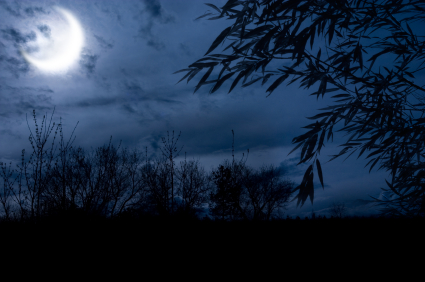
A parting of clouds in the sky tonight
Left a small moaning moon in a sea of deep blue,
And banks of grey cloud, like cliffs
Encroaching the sea,
Blushed with moonlight like white rouge.
It was stunning, allow me to say,
And insisted itself on the night
As some God-drenched canvass
Of the American west
Might insist on meaning or purpose,
A sign in the sky.
And on another night in summer, say,
In the drench of one passion or other
I might want to believe.
But it is October now
And the earth-bound world
Has its own emanations:
The smell of backyard bonfires in oil drums,
Clam bakes, chimney smoke,
And down by the lake
The sound like a stitching
The train makes on the town’s tracks.
Its whistle sings and
Dog barks echo as through a megaphone.
These redound in the brittle air
To themselves alone,
As if to say, here is the world you know,
And you have work to do.
That moon up there? It is small and cold.
The icy sea it floats in is sky,
As hollow as the barrel the dogs are barking in
Those clouds are just clouds,
Great banks of them.
And winter is closing in.
Saturday, July 23, 2011
Corner Streelight

It’s the streetlamp light we all know here
In America land
Where the pavements meet;
The shadowed porch and the windows lit
Like liquor bottle glass,
Amber and blue,
Furtive motion like rumors inside,
And the lamp lit corner where she waited
And waited as a child for you
Then stumbled home at last
Past her world she thought she knew
The shape of her diminishments in view
And wept, plain girl, into a grimy fist.
Now slaps the screen door in the August heat
And a man steps out to contemplate
The tipping of the Earth
Into another fall.
He’s lived there long enough to know
Where all of summers’ dramas ghosts will go
As you, grown gaunt in solitude,
And she have gone,
And about the murmur in the leaves
Of that dread season coming on.
So he turns inside again to sleep
Beyond the windows amber and blue
And leaves behind the lamp lit stage
Where she waited and waited
And waited as a child for you.
Tuesday, April 26, 2011
Easter: I dont know what the hell happened

by John Updike
Make no mistake: if He rose at all
it was as His body;
if the cells’ dissolution did not reverse, the molecules
reknit, the amino acids rekindle,
the Church will fall.
It was not as the flowers,
each soft Spring recurrent;
it was not as His Spirit in the mouths and fuddled
eyes of the eleven apostles;
it was as His flesh: ours.
The same hinged thumbs and toes,
the same valved heart
that–pierced–died, withered, paused, and then
regathered out of enduring Might
new strength to enclose.
Let us not mock God with metaphor,
analogy, sidestepping, transcendence;
making of the event a parable, a sign painted in the
faded credulity of earlier ages:
let us walk through the door.
The stone is rolled back, not papier-mâché,
not a stone in a story,
but the vast rock of materiality that in the slow
grinding of time will eclipse for each of us
the wide light of day.
And if we will have an angel at the tomb,
make it a real angel,
weighty with Max Planck’s quanta, vivid with hair,
opaque in the dawn light, robed in real linen
spun on a definite loom.
Let us not seek to make it less monstrous,
for our own convenience, our own sense of beauty,
lest, awakened in one unthinkable hour, we are
embarrassed by the miracle,
and crushed by remonstrance.
I posted this poem by Updike on Easter Sunday, wanting mainly to put something up for Easter—then got lost in some very academic maunderings about the Biblical accounts of the resurrection. Later, it felt inauthentic—the truth is, I don’t know what the hell to think about the resurrection story—and I was probably in over my head anyway. So I deleted it.
But I’m re-posting the Updike poem—it’s a good one, regardless of the theology. I had wanted to post something about Updike on the anniversary of his death in January, but I failed to do it. I may still—he was a towering writer, and though I have read only one of his novels I admire him greatly. A friend of mine suggests, wisely, that the poem might in fact be arguing against Biblical literalism—that’s a keen insight because Updike is clearly expressing that the wish for literalism, for a “real angel” and the “vast rock of materiality,” is just that: a wish. Another wise friend of mine says only that Easter is evidence of the “appalling naivete of Christians.” She says: “one DOES die, one doesn't go on and on, looking down from Heaven, sitting at the right hand of whomever.”
Yes, possibly. Who knows? And no one can “know” any better what precisely happened, in an historical sense, on the third day after a Palestinian Jewish mystic itinerant preacher was murdered on a cross two thousand years ago. But my original posting was an attempt to assert that there is a way to read the resurrection stories without recourse to cartoon science fiction imagery of bodies floating up from graves, that may not even be about the “next life” but about a renewed birth of vitality in this one; not about certainty regarding the afterlife, but a new freedom to live fearlessly in the face of uncertainty, death and ambiguity.
Saturday, March 19, 2011
Take Up Your Mat and Walk: The Paralytic's Friends

The Paralytic’s Friends
(Luke 5: 17-27)
It was murderous hot
And they must have had it about up to here
With hauling this guy around
On a mat.
But you know they loved him too,
They must have been friends from back in the day.
One of the five—it is always this way,
In your age or ours—has had all the bad luck.
Divorce, debt, and a stupid streak
That overcomes his better lights,
And now he’s just decided
Not to get up.
You might almost think it’s another joke—
He was always the clown—
Except that he’s gone quiet too, all shut down and sad.
The four friends want him back on his feet,
They’ve tried this and that. Dear God!
The snake oil guys that roamed the earth
In those days, a craze or fever,
Every third fellow claimed to be God,
As if earth itself, nervous at what it knew was in store,
Coughed up a swarm of lunatics.
So they’d heard about this one, and rolled their eyes.
But there were the crowds, and more than that
Was how they walked away amazed,
And when they spoke could only say
“This we have never heard before.”
And as for me, I’d been following too,
Waiting for what I couldn’t tell,
Recording the tremors at every stop.
And here I was in the back of the house,
He had just begun to speak,
When the roof began to crumble,
Dirt and straw and whatnot coming through.
There was a terrible din and the children laughed,
The old lady shouted and shook her fist
And a local curmudgeon was covered in dust.
The patch in the roof was lifted off
And in came the torturous sun
Then a shadow followed by
The mat coming through.
No one later could quite agree
Exactly what got said.
Much later, when the torpid spectacle had made the rounds,
Caressed by every broken hearted gossip,
It came down to this:
“Your sins are forgiven.”
This may be true, for all I know,
For who would not rise up,
Freed like a spring from its contraption,
From the cage of yesterdays and ancient wrongs,
The slag run-off of time and its regrets
Or hopes squandered like a drunkard’s coins,
The weight of all that past leaning in
And down on the joints of now,
On the crick in the neck, on the bone that cracks?
Who would not rise up
Were that stone rolled back
And the past revealed as an empty tomb?
Ten thousand, thousand shrieking suns
Have risen and sunk since that blasted day
When a flock of pigeons clattered up the sky
From the soot of the crumbling roof
And the crowds came and went
In the ancient clay.
Take up your analytic couches and walk!
Into your own dull daylight
Of rusted plumbing
And everything falling apart,
Take up your life as you would an ailing old friend
Whose hinges are off, whose limbs are unstrung,
Hoist him up—
Crafty, resourceful, shrewd to the end—
And walk.
Subscribe to:
Posts (Atom)