Monday, February 28, 2011

Birthers, Truthers, Love of Country, and a One-Sided Conversation about Barack Obama in the Paranoid Style

Over the weekend, I had the opportunity to “converse” with a fellow who told me the following things:
·         the Federal Reserve Bank is unconstitutional and we should return to a gold standard for the issuance of money;
·         Barack Obama hates America, is not a Christian, and was born in Kenya;
·         the uprisings in Egypt, Tunisia and elsewhere in the Arab world are orchestrated, through manipulation of the Internet, by European banks.
Call me strange, but I find blowhards entertaining. For a while anyway.  The secret is to let them talk, defer to them, throw them a question or two that panders to their need to be “expert” on whatever. And they really are expert, ready to call up fact upon fact that the benighted rest of us have missed. Regarding the last, fantastical point about the Arab uprisings, the Bank of England figured heavily. Apparently it “owns” Google. Who knew?
Now, I should say that regarding the Federal Reserve and the gold standard, I am agnostic. And I gather there are “respectable” financial types—though I believe they are in the minority—who favor a return to the gold standard. My companion clearly knew a lot about this topic, and I was happy to play the interested but uninformed one, eager to understand. From there, though, he moved on to the corruption of American politics generally (and especially of the Democratic Party), and to the uniquely lurid character of the current President. Did I mention he believes that Obama is a communist? Or was it a fascist?  
It goes without saying that any attempt to argue these points—the President’s love of country; his birth and citizenship; his religious faith; the difference between a left-of-center establishment American politician and a communist or a fascist—ran up against a wall of certainty. I didn’t really get a word in edgewise, which partly explains why I didn’t ask this gentleman what he thought about 9/11—something I very much wish I had. Because although he was obviously, transparently, a person “of the right” (Tea Party, Glenn Beck) his political alliances with the actual, real world as we know it are beside the point. “Birthers,” convinced that Obama is not an American, and “Truthers,” convinced that 9/11 was an inside job, probably do not in most cases occupy the same political territory, but they have more in common than they know, and what they share in common is a theology of political paranoia.
In the 1988 novel, “Libra,” Don Delillo weaves a fictional (but chillingly believable) account of a conspiracy behind the assassination of JFK involving embittered CIA veterans of the Bay of Pigs, Cuban exiles, mafia types and assorted right-wing lowlifes. In style and content it is very much about paranoia. All of the real life figures who were accessories in the assassination drama and who have figured in various conspiracy theories make an appearance. Among them is the gruesome David Ferrie. In a grim New Orleans bar he gives voice to the theology of Birthers and Truthers (and, for that matter, assassination conspiracy buffs) everywhere.  
“There’s something they aren’t telling us,” he whines. “Something we don’t know about. There’s more to it. There’s always more to it. This is what history consists of. It’s the sum total of all the things they aren’t telling us.”
Of course, skepticism is an entirely healthy and intelligent and necessary stance toward authority, always and everywhere. There is something salutary about the bumptious libertarianism, the don’t-tread-on-me spirit that characterizes American populism. And I think it was Harry Truman who said something about pitying the poor bastard who read the headlines in the newspaper and believed he knew the whole truth about things.
But what is noticeable about Birthers and Truthers is not so much their skepticism as their credulity; after all, it’s not what they doubt  that they assert with such vigor, but what they absolutely ,positively know to be true. Only think about what Truthers must believe, the lengths to which they must go, to accept that 9/11 was an inside job, let alone what you have to believe to think that the Arab uprisings have been orchestrated by European banks, eager to bring about a new world order.
Now the suspicions about the President’s birth and citizenship, however insupportable (see http://www.factcheck.org/elections-2008/born_in_the_usa.html), at least have the merit of being charges that can be objectively fact-checked and refuted. Speaking as one who voted for Obama, likes and admires him, I will say that he is a most ambitious individual and no doubt very narcissistic (but, please, name a successful politician who is not). One can imagine that an uncommonly ambitious and narcissistic individual might try to airbrush out of existence certain inconvenient facts in an “unconventional” background.  Healthy skepticism might allow you that much. But having imagined it, you then move on to the available facts and drop it when the facts exhaust your skepticism.
 Unless you have a willful, entirely credulous determination to believe the worst about the man. Which brings us to the charge that he “hates America”?  Never mind evidence to the contrary, what exactly does it mean to love one’s country and how would this be measured? It’s a charge that exists wholly in the mind of the believer, and is immune to criticism or proof.
Incidentally, a lot of conservative types, who won’t stoop to saying anyone hates America, have taken this cudgel up in the form of “American exceptionalism.” Here is a prediction—this is going to be a theme in the 2012 presidential election. Do you think America has an exceptional role in history? It might not be boring, and could be quite interesting to hear candidates say what they think is exceptional about America (and what isn’t) and what they think being exceptional means, and what kinds of burdens and responsibilities it places on us. (Of course, we could end up in the familiar territory of rigged election rhetoric if the question gets boiled down to “Is America the greatest country in history?” with one permissible correct answer—“Yes! Yes! Yes!”)
There are many people who dislike the President and distrust his vision for this country for entirely legitimate political reasons. But I am convinced there is also a strain—I don’t know how deep and wide—of opposition to the man that is wholly irrational. People on the left are quick to cry racism, as if it were the only form of unreason. But there are other forms as dangerous. There is, for instance, a certain kind of character who cannot stand the sight and sound of someone better, someone who reminds them too vividly of the pedestrian lives most of us live. Listen to this, again from Delillo’s novel, this time in the mouth of the real life right wing agitator Guy Bannister, grinding his teeth about JFK.
“We’re supposed to believe he’s the hero of the age. Did you ever see a man in such a hurry to be great? He thinks he can make us a different kind of society….We’re not smart enough for him. We’re not mature, energetic, Harvard, world traveler, rich, handsome, lucky, witty. Perfect white teeth. It fucking grates on me just to look at him. Do you know what charisma means to me? It means he holds the secrets…..There is not the slightest doubt in my mind but that a movement exists in the executive branch of the government which is totally devoted to furthering the communist cause.”
 It’s tempting to think that political paranoia of this sort is a modern phenomenon. Certainly, the Intenet has helped to diffuse authority, so that anyone can find a “definitive” source for almost anything they want to believe. But there is some comfort in knowing that the “paranoid style in American politics”—as Richard Hofstader’s 1964 article of the same name in Harper’s Magazine points out—has a rich and vivid history.  International bankers, Jesuits, Masons, and munitions makers, to name a few, have been among the targets.  (http://www.kenrahn.com/jfk/conspiracy_theory/the_paranoid_mentality/the_paranoid_style.html). Whether the politically paranoid line up with the right or the left, the messy and ambiguous politics of the known world—where the whole truth is never known—are really beside the point. Indeed, their certainties may be an attempt to escape from a reality that is far too random and incoherent to bear. But it cannot be a painless escape. “We are all sufferers from history,” Hofstader wrote, “but the paranoid is a double sufferer, since he is afflicted not only by the real world, with the rest of us, but by his fantasies as well.”


Wednesday, February 16, 2011

False Spring

To mark the thaw (sort of) here in northeastern Ohio, and because I have had trouble posting something lately, I'll put this up. Surely one of the most cheerless things I have ever written. I wrote it years ago, when I lived in Washington, DC. It was January or February and we had a freakish day when the sun came out and the temperature got into the upper 70s.

The turf, the earth, the loamy smell of summer grass
Exulting in the mild air
Is what we recall one day in Winter
While still in our great coat and earmuffs,
When false spring turns parks full,
Turns us free, fluid in our unscarving,
Riotously shedding our skin.

This is the day like the dream
We were desperate not to forget
It was so good,
The dream we clasped by a watery rim
And lost when we awoke,
A dream we’ve learned to fear, so painful is the falling off.

You can see then what troubles the dissembling breeze
And humbles our unbundling struts,
What chill tremors pester the leafless trees
With a foretaste of sin,
Little lies curled in our breath like smoke,
Broken promises, regret, arthritic fears
Crippling the dilapidate streets
And all the winter bondage
That frigid winds of our waking require.

Sunday, February 6, 2011

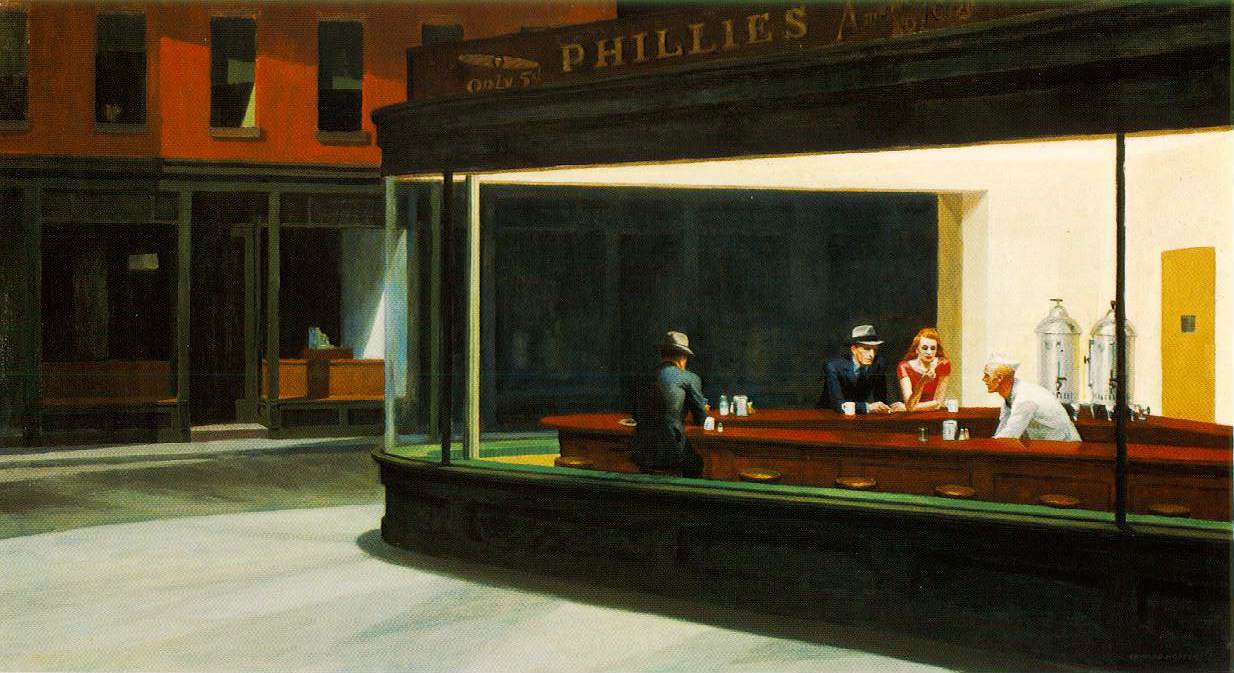
Nighthawks

It’s light that tells us how lonely they are,
Bleached yellow and harsh, that light,
Piercing even, turning to white, a pure oblivion
To match their beginnings and ends.
It migrates alive from the corner shop to the shadowed night
Animating blue-green streets, rich red brick,
Corridors of a poor commerce, a corner of time
Revealed in a light more vital than faces.
What are faces in such light but skin and bone?
It’s light that tells us how lonely they are,
That draws them together, that leaves them alone.

The coffee shop is gone. (Now Phillies are a buck.)
A laundrymat maybe, garage or bank, a fake
Has occupied the place, no home to nighthawks.
All four—the woman too, her sultriness, her sex!—snuffed out,
All but incidental, caught as they were in the same bright blast
That migrates alive through our lives
From the first cold hour to the last,
Or any hour where you and I are,
Sleepless in our separate selves.
A cruel glare reveals how alike we are
In our caul of skin and bone,
Lets us know how lonely we are,
Draws us together, leaves us alone

Tuesday, February 1, 2011

Poem for Tuesday: The Snow Man by Wallace Stevens

A reader (okay, a friend on whom I foisted this blog) recommended the following as another "quintessential winter poem" in response to my remarks about Frost's "Stopping by Woods....."

I'm grateful for this.

The Snow Man
by Wallace Stevens

One must have a mind of winter
To regard the frost and the boughs
Of the pine-trees crusted with snow;


And to have been cold a long time
To behold the junipers shagged with ice,
The spruces rough in the distant glitter

Of the January sun; And not to think
Of any misery in the sound of the wind
In the sound of a few leaves,

Which is the sound of the land
Full of the same wind
That is blowing in the same bare place

For the listener, who listens in the snow,
And, nothing himself, beholds
Nothing that is not there and the nothing that is.

Monday, January 31, 2011

Living Through Radical Times

Twenty-two years ago I was working in Washington, D.C., when one by one the countries of the former “Soviet bloc” asserted their freedom from the Soviet Union, a cascade of liberty that culminated in the Berlin Wall being torn down. I recall being made oddly aware of the smallness of my life—job, apartment, friends, the quest to “make it” or find oneself, to find a partner, or to “work through one’s issues,” all the contrivances of 20-30 something life—when the world was changing in ways that could not have been imagined even two years before. (I recall once asking a German friend, circa 1985, whether the wall would ever come down. “Not in my lifetime,” she said then.) Totalitarianism was believed to have a permanence to it that would outlast us all. The events of 1989 would overshadow all else in the history books.
Are we seeing another such revolutionary period with the uprisings in Egypt and Tunisia? (Or are they perhaps chapters in the same revolution?) There is much that is uncertain about the situation in Egypt, and much that could go wrong. I commend (again) my favorite blog, Andrew Sullivan’s “The Daily Dish” for anyone who would like to keep up with things while also getting relatively sane commentary. http://andrewsullivan.theatlantic.com/the_daily_dish/2011/01/egypt-day-seven.html

Saturday, January 29, 2011

"The Great Bridge": Civilization and the Mind of Washington Roebling

I have been reading with interest (but not without some difficulty) “The Great Bridge: The Epic Story of the Building of the Brooklyn Bridge,” by David McCullough. “The Great Bridge” is mostly social history, which is what keeps me going and it fairly vividly portrays a time in American history following the Civil War when heroic capitalism and can-do industrial and technical know-how took off. It was a period of enormous expansion of America’s infrastructure—roads, bridges, dams, buildings and cities—and there was a sense of a continental nation, having endured its Constitutional trauma in war, now prepared to seize on its enormous potential. It was really the period when America ceased to be the agrarian nation it had been up to the Civil War, and began the process of becoming an economic colossus. It was also a period of extraordinary corruption.
I say mostly social history, because the story of the Bridge is also, invariably, an engineering story. A fair amount of text is given over to descriptions of the remarkably intricate feats of architecture, engineering and construction required in putting a suspension bridge over the East River between Brooklyn and Manhattan. If you are like me and do not easily or naturally envision mechanical and spatial images, these passages can be a bit of a trudge. For the most part though it is enough to have a general feel for the purpose that is being pursued in any given passage to get by.

On reflection I would say that the difficulty of following some of these descriptions is itself instructive. Those of us who live and function in the realm of words and ideas may please ourselves with the notion that words and ideas are what make the world go round. But the world goes around more reliably because of people who build the things that make the world accessible  and convenient. Civilizations need bridges and the people who build them, need minds that can conceive of how to sink two massive caissons (or chests, from the French) the size of football fields into opposite ends of a river to serve as foundations for stone towers, then sling steel cables from tower-to-tower and from the cables attach wires that will suspend the bridge. 

“The Great Bridge” is largely the story one such inspired mind, that of Washington Roebling. Actually, it was Washington’s father John, who originally conceived the building of the Brooklyn Bridge and was in charge of its initiation. But John was to be a casualty of work on the Bridge (he would not be the only one) and died after a freak accident early on. I have to say that this was fortuitous for the telling of McCullough’s tale, because John Roebling, though he may have been brilliant, was a somewhat weird character with a touch of the sinister about him (he appeared to have abused at least some of his children). His son Washington stepped into the breach. A veteran of several Civil War battles, including Chancellorsville and Gettysburg, Washington was a soldier’s soldier. He had a cast iron work ethic, and an attention to detail that was unflinching. Much of the first half of the book is devoted to the sinking of the caissons in the river to serve as the foundations for the two great towers facing each other ; picture two massive chests constructed of steel and timber, each the size of football fields and open at the bottom like an enormous breadbox lid. These were dropped into the river, open side down, and filled with compressed air; then workmen were lowered by means of pneumatic tubes into the caissons where they dug out the riverbed, while up above stones were piled onto the caissons to sink it into the riverbed until it rested on bedrock. Roebling himself spent much time in the caissons (at one point a fire broke out in the Brooklyn caisson and Roebling was on hand to fight it) and from these excursions suffered several bouts of the Bends (or Caissons disease, the proper name for the disorder arising from the formation of nitrogen bubbles in the bloodstream when an individual emerges too quickly from decompression). A great many workmen in the caissons of the Brooklyn Bridge fell victim to the Bends (a few of them died) and great advances in understanding the disorder, and how to prevent it, were made because of the Brooklyn Bridge experience. Roebling’s bouts with the disorder (as well as nervous exhaustion) caused him to have to take a leave, but he returned to direct the construction of the bridge from his sickbed miles away in Trenton, New Jersey.
The end result, of course, is a technical but also an aesthetic marvel, and it is worth the read to realize that the mind that  managed this feat was no less inspired than the mind that conceived the Declaration of Independence.

McCulllough quotes Lewis Mumford, in the 1920s, as saying that the Bridge proved that industrialism need not be synonymous with ugliness. "All that the age had just cause for pride in--its advances in science, its skill in handling iron, its personal heroism in the face of dangerous industrial processses, its willingness to attempt the untried and the impossible--came to  a head in Brooklyn Bridge."

Tuesday, January 25, 2011

Hitchens on The King's Speech

Alas, my favorite writer has some harsh words for my favorite movie (see posting below on "The King's Speech")--well, the only movie I've seen of the major Oscar contenders.

Hitchens' complaint is not with the movie--which he says is excellently made with an appealing human story--but with  the "bad history" that draws on what Hitchens calls "the cult of Winston Churchill."

Well, read for yourself.
http://www.slate.com/id/2282194/