Monday, February 20, 2012

Injured: The Pointlessness of Physical Pain, The Madman Below My Ear, A Laying on of Hands, and Two Final Thoughts

No pain, no gain, goes the modern trope.
I think, I hope, I believe, that this is emphatically and undeniably true when it comes to the pains of the spirit, to emotional suffering, to living through and beyond such tragedies of human life as divorce, the death of loved ones, the disappointment engendered by people one thought of as friends, the realization that one’s own life is short and bound on all sides by compromise. And so on. Like most people my age, I have come upon some of this and it is a source of much wonderment to me that however much some of this experience was a source of real, emotionally painful bewilderment—some of it quite nightmarish—it is also true that all of it has made me somehow better, more human, emotionally richer, wiser, more mature, less one dimensional.  It has caused me to look at my own contribution to things that have gone wrong, has (occasionally) made me more forgiving, and—the very best thing I think—has caused me to move out of my comfort zone, try new things, to go in new directions. It strikes me that this phenomenon is the source of all philosophy, and it has a pedigree in most religious traditions.  “[W]e rejoice in our sufferings,” the apostle Paul says famously in Romans, “knowing that suffering produces endurance, and endurance produces character, and character produces hope, and hope does not disappoint us…”
But I wonder…Can the same be said of physical pain? I have been mercifully healthy (for the most part) all of my life, and all but entirely free of any really physically painful conditions. But very recently, as a result of the combination of several exercise activities, I have, in the parlance of sports announcers, “sustained an injury.” Actually, it was an aggravation of an injury I “sustained” four months ago, to my shoulder. Turns out (as revealed by an X-ray) I have some arthritis somewhere where the arm bone meets the shoulder socket. Stress on this mechanism inflamed the arthritis. The latter causes its own severe discomfort, but the inflammation also impinges on a nerve that radiates from the neck down to the middle of the forearm.  The result is that in addition to the dull ache of the inflamed joint, there is a more acute, piercing pain very similar to sciatica—the condition wherein nerves that radiate down one of the legs are impinged upon by prolapsed bones in the lower spinal cord.
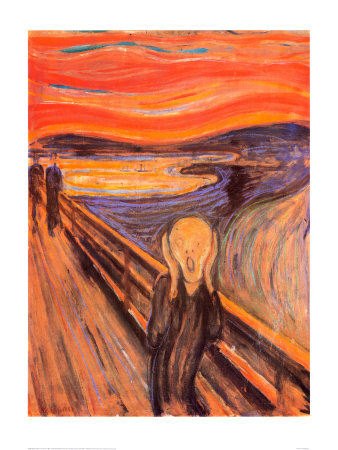
How to describe the full effect of this orthopedic mischief in my shoulder? It is like having an extremely furious and wholly insane individual seated slightly below your ear and screaming at an almost impossibly high pitch, in periodic and unpredictable intervals. Another image I take away from the experience is that of a cartoon bully, perfectly mute and inarticulate, relentlessly punching you in the face (in my case, in the shoulder) for the joyless pleasure of letting you know he can do it. Someone I know made the smart remark that the nearer pain is located towards your head, the more distracting it becomes, an observation with which anyone who has had a severe toothache can resonate. For a day or two there before I got to the doctor’s, I think—no, I know—I was slightly nuts. My perception of reality was continuously fractured, having to tend every few minutes to the screaming madman below my ear, so that I could focus on nothing—including the work for which I get paid—for more than a few minutes.  My house became even more disheveled than usual because such simple, arm-and-shoulder dependent tasks as washing the dishes and sweeping the kitchen floor caused me, after twenty minutes, to wish I had a chain saw with which to disengage my arm from my body. I have had to temporarily suspend those things—a mediocre tennis game, a little yoga, and a much-less-than-mediocre piano practice—that give me a lot of pleasure.
On the short end of recovery now, I can find almost nothing positive about the experience. It was diminishing in every way. It taught me—thanks very much!—that I am not the man I used to be and can’t do the things I did ten or twenty years ago. Swell. Any more positive feelings—gratitude for doctors and nurses and therapists and for modern medicine, thankfulness for pain free use of my limbs—were the result (make note!) of recovery, of release and relief from pain. As for those times when my shoulder and arm were at their most opinionated, believe me when I say that gratitude was the farthest thing from my spirit. I would regard you and everyone else who came within my path as an imbecile determined to make my life more miserable than it already was.
Yeah, yeah….I did my manly best to suck all this up and keep it indoors and I would like to think I was more or less successful. Whether I was or not, you will have to ask those few people who had to deal with me up close. But the truth, I know, is that the entire experience reduced me to something like a moderately intellectually disabled, immoderately immature teenager with an attention deficit disorder.
All of which has caused me to think about, as a contrast to the paradoxical usefulness of emotional suffering, the remarkable pointlessness, the uselessness, of physical pain.  And the imperative to vanquish it, whenever and wherever it exists. It is one human condition that seems to lead nowhere, that points to nothing other than the most brute facts of existence—you are small and finite and at the mercy of nature—without offering something redeeming in return; or else the return is diminishing and not commensurate with the cost.  Physical pain is universal—no one will escape it entirely—and it may be that what can be said for pain is that it reminds you what it is like not to be in pain. But, again, that presupposes a recovery, which may not necessarily be in the natural course of things and may be dependent on someone who cares enough (or is paid well enough) to help relieve you. And anyway, I don’t want to give too much ground on this, because the bargain (if that’s what it is) seems to me to be a swindle—you lose too much and become too diminished in the transaction. Hitchens dealt with this in one of his last pieces before his painful death from esophageal cancer, taking on that cliché about things that don’t kill you making you stronger. (Evidently, some things can make you weaker and then will kill you anyway.)    
And on the side of recovery one has to credit the work-a-day diligence of those doctors and nurses and therapists whose job it is to vanquish pain. When I first visited my doctor four months ago with my initial, less severe, experience of this injury, this doctor—whom I have come to trust and revere—discussed various treatment options. Physical therapy was a given, but there were medicines, anti-inflammatories of varying potencies to consider, along with their possible side effects. At the time I recall that when I showed up at the office my symptoms had somewhat mysteriously subsided, so there was some legitimate question whether a prescription was necessary. And I recall that as he was reviewing my chart, and without quite looking at me, he wondered in a seemingly off-hand, and possibly whimsical way, if perhaps “a laying on of hands” would be enough. Whimsical though it may have been, I am quite sure he was in no way diminishing the severity of what I had experienced. Smart doctors, I think, know all about the “laying on of hands,” know all about patients who “mysteriously” get better when they get a little attention, a little assurance that they aren’t going to be killed by what they experience. Who has not felt better, a little bit anyway, entering the work-a-day hum of a doctor’s office and knowing suddenly that so much trained, perfected expertise cannot but prevail against some trifling symptom?
I did get a prescription, then, and took some physical therapy, but realize now I didn’t take it seriously enough. Which explains why I was back four months later. This time, I saw one of my doctor’s colleagues, a sharp, friendly young woman who intuited quickly how agonized  I was, tried to amuse me with some humor, laughed readily at my own attempts to make light, wrote me a prescription for a short course of low-dose prednisone and some extended physical therapy, invited me to call at the drop of a hat, assured me that if some more specialized attention was necessary it would be ordered immediately, and sent me on my way. Once again, my kindest feelings about physical pain are all on the side of those who do what they can to get rid of it.   
Two last thoughts: The pointlessness of physical pain, once you have experienced it yourself, seems to me to be the last word anyone should need on why not to inflict it on anyone else, including one’s worst enemies. What cause, short of the most immediate need for self-defence, is worth becoming that cartoon bully, the messenger that life is an empty shell?
And then this: some 15 years ago, I wrote a little bit in a professional way about advocacy, on the part of some physicians who specialize in pain management, for the legalized use of heroin in terminally ill patients for whom morphine isn’t enough. I believe its use has long been legal in the United Kingdom, but I am entirely unsure of its legal status in the United States and have long since lost track of this subject. Back then, the cause had a seemingly unlikely champion in William F. Buckley (seemingly, I say, because Buckley could be counted on to take on some esoteric subjects and adopt some surprising stances). In any case, he was for it and so am I. There is an argument against this, about the dignity of human beings in their last days, about the integrity of human suffering, and about how people ought perhaps not to be subject to treatments in death they would never consent to in less dire circumstances. It is a potent and valuable and substantive and elegant argument, and I say the hell with it. And I say: Vanquish the pain! Because the last thing anyone needs to be reminded of, particularly when they are dying, is about pointlessness.  

Thursday, February 9, 2012

The Sadness of Men Trying to Keep Up: The Descendants

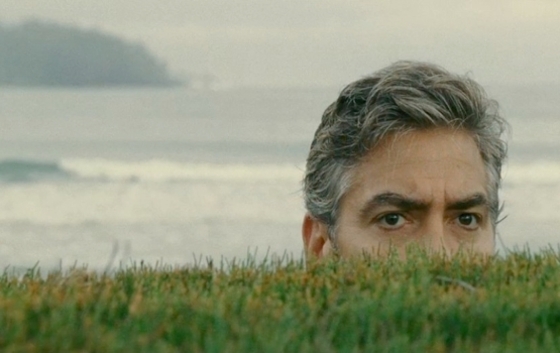
Anyone left who hasn’t seen The Descendants has almost surely seen the trailers, in which George Clooney—playing a wealthy Hawaiian lawyer and landowner named Matt King—is running. And running, in various ways, he is throughout this beautiful and sad and funny film. He runs, in sandals, from his house to a neighbor’s to demand what they know about the affair his gravely injured wife was conducting before her boating accident; he runs up and down a beach in search of the intruder in his marriage. And, figuratively, he is running to keep up with--or keep ahead of--a torrent of misfortune; and running to catch up with the children he has allowed, in the conventional male way, to run ahead of him while he was busy earning the privileges (private schools, a lush Oahu island home) that allowed him to think it was okay for him to be, as he says, “the back-up parent.”
   It is not at all incidental that in those scenes in which he is literally running, he looks distinctly like someone who is, well, Not A Runner. Pumps his arms a little too fast, strides a little too short. (And any daily runner would have a pair of sneakers, at least a pair of old beaters, to slap on in the case of an emergency like needing to run down the canyon road to find out from the neighbors who his wife was screwing behind his back.)
   The more I think about this movie the more I think it is, at least in part, a story about male competence, and incompetence. And that it is a far prettier, smarter, and less pretentious story (one that strives, certainly, to be more Hollywood-mainstream) than Sideways, also directed by Alexander Payne and also about the woes and competencies and incompetencies of middle-aged men.
   The sadness of guys, trying to keep up. They, we, seem to be on the ropes, everywhere. Matt King is on the ropes and as imperfect as his jogging appears, he seems to be even more less-than-perfectly-competent at almost everything else he is trying to keep up with. Most especially his daughters, the younger of whom is texting cruel and “inappropriate” comments to classmates, and the older of whom, Alex, is honing the conventional stance of snide cynicism teenage girls seem to have toward all adults (perhaps, especially males) and selectively their parents (perhaps particularly their fathers, for whom they also yet reserve a touchingly ill-concealed desire to love, if only dad wouldn’t act so ridiculously embarrassing). Alex is also working on a possibly incipient case of alcoholism. More about this particular teenager and the actress who portrays her later.
   But for all his imperfection, Matt is also, through and through, a Pretty Good Guy, doing his best. I had the interesting, passing thought early in this movie that George Clooney didn’t seem to be working too hard, that maybe this role wasn’t too demanding. Which either suggests that he knows all about being Matt King, or that he was doing a piece of very fine acting. A female friend I saw this with commented later that (hold your breath for a surprise) she normally finds George Clooney attractive—but didn’t find him attractive in this film; by which I think she means to suggest that the actor had made himself in his role somehow physically unattractive, which would suggest a very, very, very good acting job indeed.
   But I think I understand that. Because the attractiveness, especially the sexual allure, of men is so allied with the projection of confidence, of competence. And when their need for the affirmation of others becomes too acute they can seem to be un-manned. Yet (and I know these generalizations about gender can seem tiresome) men never seem to need too much. My father, whenever his birthday rolled around, would tell us as a kind of regular joke whenever we asked him what he wanted that he would be satisfied with a “kind word.”
   Matt King is a man sorely in need of a kind word. The most memorable scene and the one most emblematic of this very competent but out-of-his-depth man’s need for a consoling word is after the decision has been made—mandated by an advance directive—that life support will be withdrawn and that his wife will die. Friends and immediate family are invited to bid goodbye to the woman. Her father, Matt’s father-in-law, is a hard type and something of a knucklehead who uses the occasion to berate Matt for his failings. Whereupon daughter Alex speaks up and says, “Hey my father’s doing a really great job in a difficult situation.”
   This is the occasion of a really priceless piece of acting when George Clooney is seen doing a double, or triple, or quadruple or maybe quintuple take at his daughter, madly desiring in a situation of impossible protocol, to wrap his arms around the girl and hug her to death. I certainly wanted to.
   About this actress, Shailene Woodley. She has received richly deserved attention for her role, but I think she was robbed of an Academy Award nomination for best supporting actress. Because this young lady nailed this role to the wall. The mouthiness—what is it about teenage girls that causes their angst to come screaming through their teeth?—the insouciance, and then the casual, unexpected brilliance and grace that makes you wonder if maybe they really are (as they assume) smarter than you. And the way they mature so much faster than you could have anticipated, as Alex does progressively in this film.
   I love the traditional Hawaiian music that permeates the movie. The resolution of the land deal at the end makes sense in a way I didn’t think it would. And in the end Matt and his daughters are lounging in a sofa watching a movie being narrated by Morgan Freeman. I didn't catch it at the time, but read later that the movie is March of the Penguins. About mammals who learn through adaptive evolution how to nurture their offspring in what seems like impossible circumstances.

Thursday, January 26, 2012

"Anxiously Awaiting an Answering Voice Amid Utter Silence"

I have for the most part, written off reading Charles Krauthammer because he has become as predictable as death and taxes in his disparagement of everything that Barack Obama says or does or tries. And he is one of the most consistent purveyors of the right wing line about Obama-as-Off-the-Grid: redistributing income, coddling and apologizing to our enemies, disavowing American exceptionalism, and shamelessly pandering to the progressive left. (Never mind how disappointed the progressive left has been in Obama). And Krauthammer is unrepentant about the Iraq war and in general the entire neo-con approach  that reigned for eight (ruinous) years.
   But I have come across, a few weeks late, this brilliant and beautiful column by Krauthammer about the search for intelligent life in the cosmos. Money quote:   

“As the romance of manned space exploration has waned, the drive today is to find our living, thinking counterparts in the universe. For all the excitement, however, the search betrays a profound melancholy — a lonely species in a merciless universe anxiously awaits an answering voice amid utter silence.”

And this:

“…this silent universe is conveying not a flattering lesson about our uniqueness but a tragic story about our destiny. It is telling us that intelligence may be the most cursed faculty in the entire universe — an endowment not just ultimately fatal but, on the scale of cosmic time, nearly instantly so.”

And, finally, this:

“Rather than despair, however, let’s put the most hopeful face on the cosmic silence and on humanity’s own short, already baleful history with its new Promethean powers: Intelligence is a capacity so godlike, so protean that it must be contained and disciplined. This is the work of politics — understood as the ordering of society and the regulation of power to permit human flourishing while simultaneously restraining the most Hobbesian human instincts.
“There could be no greater irony: For all the sublimity of art, physics, music, mathematics and other manifestations of human genius, everything depends on the mundane, frustrating, often debased vocation known as politics (and its most exacting subspecialty — statecraft). Because if we don’t get politics right, everything else risks extinction.
“We grow justly weary of our politics. But we must remember this: Politics — in all its grubby, grasping, corrupt, contemptible manifestations — is sovereign in human affairs. Everything ultimately rests upon it.
“Fairly or not, politics is the driver of history. It will determine whether we will live long enough to be heard one day. Out there. By them, the few — the only — who got it right.”

And it follows another really brilliant piece he wrote about the discovery of neutrinos that travel faster than the speed of light. http://jewishworldreview.com/cols/krauthammer100611.php3

I wonder if Krauthammer could be persuaded to give up writing about politics and take up being a full-time science writer.

Thursday, December 22, 2011

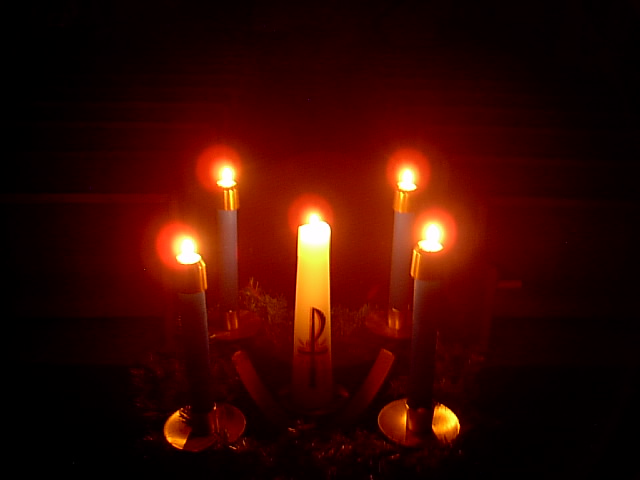
The Absence: An Advent Meditation on Faith, Doubt and Uncertainty

The presence of an absence—I first heard that phrase used at the Holocaust Museum in Washington, D.C., to describe the vanished Jewish communities of Eastern Europe, an absence felt as an enduring rebuke to easiness. In an infinitely happier way, it is what you might experience at the Abbey of Gethsemane, in the sanctuary and the halls of the guest quarters, in the garden and in the acres of fields and hills that surround the monastery—a sense that in the pregnant silence that pervades the place there is concealed something protean and organic, concealed because you have to befriend this silence and listen to it, something truer and more real that you have known in the realm of sound and fury that most of us live.

 The place has that kind of effect on people, in part certainly because silence—like its sister, solitude—is experienced infrequently by many, for whom these monastic staples are vaguely shameful. I went to Gethsemane for the first time, two autumns ago, uneasy about a long weekend of total silence, solitude, and what I anticipated as mandatory solemnity, and left after three days feeling I had been on a month-long vacation. I live happily in the wired world of the Internet and smart phones, of argument and opinions and words—words, words, words—and appreciate all the ways that humans make noise in the world, but you can’t really know the extent to which this noise is a burden and a distraction until, for so little as a day, you turn it off.

But I don’t doubt that many others experience the silence of Gethsemane—or silence and solitude wherever they seek it out—quite differently, as the absence of a presence, empty of greater meaning, and resist what they regard as the tricks of the mind to fill the void with comforting emanations from without. And they are happy to regard the silence as a blessing in itself, a vacation from noise and bullshit and exhortations to empty one’s wallet.

More and more do I experience it that way myself. There were times in the past, including times of my most momentous and fateful decisions, when I felt—or imagined I felt—something like what some people have described as the “hand of God” at work in my life. I believed, or convinced myself to believe, that I was “doing God’s will.” In silence, I was aware of a presence.

Not so much anymore. Absence is what I have become aware of, absence and randomness—which is the awareness of the absence of order, of a rational scheme to things—and the indifference of nature. Age certainly has something to do with this. So too does being a parent; this experience does all kinds of things by way of making you more human, and one of those things is to make you starkly aware (as opposed to merely intellectually cognizant) of how little control you have…over anything. It is one thing to nod your head when you hear that the rain falls on the just and the unjust, that bad things happen to good people, and even to accept that despite all your good intentions bad things have happened to you, but it is quite another thing altogether to realize that your child’s life is subject to a fate that is entirely random and capricious and utterly indifferent to the annihilation of your heart.


 Losing my parents likely has had something to do with it as well; one does feel, even at 50, orphaned, adrift from one’s moorings, out at sea. I recall when my mother died two summers ago I went to look out at Lake Erie, wondering if I might sense something of her presence; instead what I felt, if anything, was her leaving. A strong wind was up that morning and the brush and tall grass that cover the slope leading down to the lake, and the weeds and shrubbery between the rocks of the breakwater were blowing about madly. My mother had had a long decline that was painful to watch since she had left us in every essential way long before she actually died, and I could only think that if there was any emanation at all it was that of her spirit, released at last from old age and the clutches of modern medicine, somewhat violently shaking loose of the world. And, of course, the death of one’s parents leaves you with a clearer vision than before that your own little narrative also has a beginning, middle and an end.

 And yet I am not (I hope) talking about an absence of faith, not talking about the “loss” of my faith, only about the forfeit of what I hope to say are the shallower promises of “certainty,” which I also hope to say is a counterfeit of faith. Absence, darkness, skepticism and doubt, an acute perception that you and I live on the edge of a precipice and that there are a thousand and one ways that people will slip and fall—these may be obstacles to certainty (if that’s what you want) but to faith I don’t believe they are so much obstacles as the cold, sharp stepping stones to a deeper one.

Absence is written into the Judeo-Christian sacred stories: Jonah in the belly of the whale; Christ in the Garden of Gethsemane; and most hauntingly in the cry from the cross, “Why hast thou forsaken me?”  St. John of the Cross’ La noche oscura de la alma has made the “dark night of the soul” a staple of the language of discipleship. And the signature music of the Medieval period, assumed to be a era of credulity and unquestioning belief, seems to me to be a music of absence; the silences and hollows and mournful echoes of the Gregorian plainchant reflect an era that understood better than ours that life could be cold, harsh and random, that G-d could seem to be absent.

Still, faith is allied in many minds with certainty, with fiery conviction, with a refusal to entertain doubt, a refusal to rest easily with the absences in silence. Faith-as-certainty is not a modern phenomenon by any means—it is a (dangerous) temptation anywhere, anytime of any faith whose object is one of ultimate concern—nor is it by any means exclusive to any particular brand of faith. But living as we do in an age when religion has been politicized and weaponized—and the weapons to which it might lay claim are ultimate—it should not be surprising that in the decade since the terrorist attacks of 9/11, this notion of faith-as-certainty has come to be viewed as frightening and dangerous.

And we have witnessed in our time as a counterforce a new confidence of atheist writers and thinkers—Christopher Hitchens, Richard Dawkins, and Sam Harris among them—who have prompted many closeted doubters who have been silently seething beneath the noisy cultural dominance of religion to come out and declare themselves as skeptics. Leave aside for the moment that they speak with their own brand of certainty; speaking personally, I think (as I have said elsewhere on this blog) this is a positively good development for faith by forcing it, so to speak, to clear its voice and say what it means, and what it doesn’t mean, and to confront its contradictions and stupidities. Moreover, to the extent that anyone comes to their atheism or their skepticism honestly, through soul searching and contemplation, and are honest in their assertions about their reverence for science and reason (for these are what atheists typically claim to hold in highest regard) it must be admitted that they are taking their lives and their souls and the questions of faith more seriously than do many people whose religious convictions are reflexive and automatic.

Now, I have read “God is Not Great: How Religion Poisons Everything,” by Christopher Hitchens (he was a favorite writer of mine, apart from his ideas about faith; his recent death is an enormous loss) and I did not think it was a brilliant piece of work. He reads the Bible in as hamfisted a way as any fundamentalist, and misses entirely great themes of scripture—the liberation of peoples from bondage and servitude in the Old Testamant; the radical way in which Jesus continually transgresses against the cultural norms and power structures of his day in the Gospels; the transcending of religious tribalism and racial boundaries that marks the apostleship of Paul and the growth of the early church—that he might, as a humanist and internationalist, have appreciated.

But Hitchens, who liked to mock the “celestial dictatorship” that he says people of faith are wishing for, has an argument that the faithful should confront, and which is directly relevant to whether faith can encompass doubt and skepticism. The argument is this: The fascist and totalitarian instinct in politics and society is related to the human wish for an Absolute Answer that will absolve us of the uncertainty, doubt and ambiguity that plagues us in life, the wish for a Presence that will fill up all of the absences we feel in human existence. That kind of Presence, abolishing uncertainty, is bound to be tyrannical; HItchens compares the image of G-d to that of “Big Brother,” and denounces with disgust the fact that religion (so he claims) commands us to “love that which we also fear—the essence of sadomasochism.”

In this, Hitchens and his atheist compatriots are arguing against faith-as-certainty, and I can only say that to that extent their point is inarguable. The disciples of something like a Celestial Dictatorship, eager to inflict their version of The Truth on everyone around them, are legion. But it is also more than arguable that their certainty is not the faith of the Bible, and that the Celestial Dictatorship described by Hitchens is not the G-d who revealed himself in Jesus Christ.

What, then, is faith if it is not about “certainty”? For myself, I find it useful to think of faith not as a matter of assenting to certain creeds or beliefs, but as fidelity, an intentional “staying with”—staying with the difficult marriage or relationship, the hopeless or perilous situation, the friend or stranger in need. Think of Christ in the Garden of Gethsemane lamenting that none of his friends would stay awake with him. Think of it also as an intentional staying with—or staying awake to—life itself, of living with eyes wide open, a determination to participate fully in one’s life, whatever its circumstances or trials, and however full of darkness and absence it may at times seem.

In the novel To Know a Woman by Israeli author Amos Oz there is a charming depiction of a secular version of something like this kind of faith-as-fidelity. Yoel Ravid is a middle-aged widower, taking care of his aged mother and mother-in-law and teenage daughter in the wake of his wife’s death under mysterious circumstances. In the last pages, after a convoluted plot reaches an ambiguous resolution, we see Yoel working as a volunteer in a hospital, comforting patients and doing various odd jobs.

The first few times he was mainly set to work in the laundry….Yoel’s job was to sort out what had to be boiled and what needed a delicate wash. To empty the pockets of the dirty pajamas. And to enter on the appropriate form how many sheets, how many pillowcases, and so forth. Bloodstains and filth, the acrid smell of urine, the stench of sweat and other body fluids, traces of excrement on the sheets and pajamas, patches of dried vomit, medicine stains, the intense whiff of tormented bodies—all these aroused in him neither disgust nor loathing…He yielded himself to it with silent elation: I am alive. Therefore I take part. Unlike the dead.

The novel’s conclusion has a pleasant convalescent feel to it, such as one experiences when an enormous tension has been resolved. 

And so Yoel Ravid began to give in. Since he was capable of observing, he grew fond of observing in silence. With tired but open eyes. Into the depth of the darkness. And if it was necessary to focus the gaze and remain on the lookout for hours and days, even for years, well there was no finer thing than this to do. Hoping for a recurrence of one of those rare, unexpected moments when the blackness is momentarily illuminated, and there comes a flicker, a furtive glimmer, which one must not miss, one must not be caught off guard. Because it may signify a presence which makes us ask ourselves what is left. Besides elation and humility.

Dietrich Bonhoeffer, from his prison cell where he was held by the Nazis before being executed for his part in the officer’s plot on Hitler’s life, famously sketched out a more theological vision of faith for modern Christians living in “a world come of age,” a world in which he says “before God and with God we live without God.” In several ways, his thoughts—though he never got to formally expand on them—speak powerfully to contemporary challenges to faith and to the need to embrace uncertainty and absence. “I discovered and I’m still discovering right up to this moment,” Bonhoeffer wrote,


“…that it is only by living completing in this world that one learns to have faith. One must completely abandon any attempt to make something of oneself, whether it be a saint or a converted sinner or a churchman (a so-called priestly type!), a righteous man or an unrighteous one, a sick man or a healthy one. By this-worldliness I mean living unreservedly in life’s duties, problems, successes and failures, experiences and perplexities. In so doing, we throw ourselves completely into the arms of God, taking seriously not our own sufferings but those of God in the world—watching with Christ in Gethsemane. That I think is faith; that is metanoia [repentance]; and that is how one becomes a man and a Christian.”

 For Bonhoeffer, God’s presence is found not in strength—not in signs and symbols and sound and fury that the adherents to faith-as-certainty look for (and that the disciples of Celestial Dictatorship wish for)—but in weakness. “God lets himself be pushed out of the world on to the cross,” he wrote. “He is weak and powerless in the world and that is the way, the only way, in which he is with us and helps us.”

G-d, then does not exist in the world to provide Absolute Answers to our uncertainties and ambiguities, but as a as a companion, suffering with us in the absence and randomness and indifference of nature, and inviting us to solidarity with Him and with each other, and with all of suffering creation. In this may be the essential Christian—and Christmas message--Emanuelle, God With Us.

From the jail in Tegel, where Bonhoeffer wrote to his family and friends, he told his confidant Eberhard Bethge early in December 1943 that “a prison cell, in which one waits, hopes, and is completely dependent on the fact that the door of freedom has to be opened from the outside, is not a bad picture of Advent.”

And Advent is not a bad picture of the life-in-waiting that characterizes the human condition, suspended in a state of uncertainty, of incomplete knowledge, at times painfully aware of the absence of that which we still wait for. So we wait with open eyes in the darkness until, at any moment, the door is opened and a new light is shed—at which time possibly, and possibly well before we die, we will know something else.

Wednesday, November 30, 2011

J. Edgar: Not Epic Enough

In Clint Eastwood’s J. Edgar, the legendary FBI director describes Richard Nixon—the mirror image of Hoover's own internal repression and manifest unscrupulousness—as “immense.” It would be an apt term for Hoover himself. Long ago, before revelations about his corrupt use of covert information to blackmail and frighten virtually everyone in Washington, and before speculation about his personal life marred his reputation, Hoover occupied an immense place in the nation’s imagination as a crime fighter extraordinaire. He significantly shaped a Cold War-era sensibility about the vulnerability of the nation to internal threats. And he was, along with Nixon and Kissinger, a prominent player in the debauchery of democracy at that time, an American Caligula whose special fondness for using covertly obtained information about sexual indiscretions to blackmail the powerful reflected a vast insecurity about his own sexuality.

In seeking to encompass this immensity on the screen, J. Edgar endeavors to tell at least four separate stories. They are these: 1) how Hoover was moved by the violence of the “Red Scare” in the early 1920s to found a new crime-fighting division within the Department of Justice, using “scientific” methods such as fingerprinting; 2) the growth of the FBI into a national icon, and of the myths of the “G-man” and of Hoover’s own personal involvement in such celebrated Bureau success stories as solving the mystery of the Lindbergh baby kidnapping, and the shooting of John Dillinger; in both cases Hoover's involvement was exaggerated or wholly fabricated in the service of his keen talent for public relations and hunger for adulation; 3) the long-time, occluded relationship Hoover maintained with aide Clyde Tolson, widely—but not unanimously—assumed to be homosexual in nature; and 4) the use Hoover repeatedly made of personal, especially sexual, information for purposes of blackmail or intimidation, most notoriously in the case of Martin Luther King when the Bureau forged a letter to King encouraging him to commit suicide.

In telling these stories reasonably well, and with the technical panache for which Clint Eastwood is admired, the film tells none of them exceptionally well and succeeds mainly in revealing the timid, emotionally clotted figure behind the fabricated G-man image. The result is curiously deflating, and emotionally distancing. And there are some distinctly odd aspects to this movie. Most notably, there is the matter of cosmetics as the characters age—what one reviewer called “ghastly slatherings of old age make-up”—and some really freakish attempts to approximate the appearance of certain real life characters. Hoover himself is done reasonably well as a corpulent senior, but Clyde Tolson—handsome and dashing as a young man—looks positively entombed as an old one. Robert Kennedy appears to be weirdly and witlessly grinning throughout a conversation with Hoover in which the latter is blackmailing RFK’s brother, and the Nixon that appears in J Edgar has to be the most comically absurd attempt at verisimilitude ever put on celluloid. If there is some stylistic comment being made here—i.e., that all politicians wear masks that are grotesque covers for their distorted real selves; or that Tolson entombed himself through a life of slavish devotion to Hoover, etc.,—it is lost in the plain strangeness of these devices.

Leonardo DiCaprio is quite good in his role, especially as the younger J. Edgar. And the relationship with his imperious mother is very well rendered. But even here there is something all too predictable and diminishing. Of course, Mother is a domineering bitch sculpting her son in the service of her own narcissistic needs, instructing him early on like a wind-up toy that he is to gain back the family “glory” and compensate for the (of course) alcoholic failure of a father, all the while smothering her son sexually and ruthlessly condemning the homosexuality of which she must have been aware early on (“I’d rather have a dead son than a daffodil,” she tells him.) Judy Dench plays this thankless stereotype about as well as it can be played—I can imagine an Academy Award nomination—and the film does convey the sense of a loveless maternal magnificence to which Hoover might have been captive.

The movie also deftly leaves open to interpretation the precise nature of the relationship between Hoover and Tolson. That they were gay lovers has been disputed by some who knew both men well, and who plausibly argue that Hoover—exquisitely, one might say, expertly sensitive to the damage that personal indiscretions could do to reputation—served in a time when a revelation of homosexuality spelled the end of a career. But the most sensational of whispers, that Hoover participated in crossdressing rituals (a rumor that has been roundly disputed and never corroborated), is hinted at obliquely in the film when, after his mother’s death, he dons her pearls and dress.

Whatever the truth about Hoover’s sexual life—I think it is possible to believe that the relationship with Tolson was an idealized gentleman’s affection that substituted for a physical intimacy of which Hoover may have been incapable—what’s clear is that there was a relationship between his own tortured sexual ambivalence and the paranoid use he made of sexual blackmail. There is the real fascination of the Hoover story, insufficiently captured in this film: the occult relationship between profound emotional dis-jointedness, closeted sexual instincts, and political corruption, especially in the case of one who exerted such a vast influence over politics for close to five decades.

All the more fascinating is the fact that late in his life, and at a peak of Hoover’s power, he had a rival in political psychopathy in the figure of Richard Nixon. It is quite interesting and insightful, I think, that the Hoover  of this movie recognizes that in Nixon he may have met his Machiavellian match. And equally penetrating that it is Nixon, alone among the politicians Hoover faces off with, who crudely identifies the FBI director for what he is (“that cocksucker,” Nixon calls him) and who is determined to wrest from Hoover after his death the “personal” files that gave Hoover his sway over everyone in Washington. (We may assume, also, that in Nixon, Hoover was confronted with a figure not likely to provide the kind of blackmail-worthy sexual indiscretions that filled that file.) The movie depicts the files being shredded by Hoover’s ever loyal secretary Helen Gandy, but in fact much of the contents are available for public reading in the National Archives. In a November 9 article in the Washington Post, Kenneth Ackerman, author of “Young J. Edgar: Hoover and the Red Scare, 1919-1920,” writes that the files “paint a stark portrait of power run amok.”

Nixon outlasted Hoover. But there is cunning to history, and even after his death the figure of Hoover exerted an influence over events. Nixon was determined to appoint a non-entity as a successor to the directorship of the bureau—and did so in the person of J. Patrick Grey—the better to tame the bureau and politicize it in the service of the vast crimes that were the Watergate scandal. But Mark Felt, a long-serving FBI agent and associate director had long coveted the job, and it was partly out of revenge for being passed-over that he betrayed Nixon, serving as the Washington Post’s famous “Deep Throat” source, helping to bring the President down.

It should take the breath away to realize that during a period of peak domestic discord, the two most powerful positions in government were held at the same time by men afflicted with extraordinary paranoia and severe disorganizations of personality. The wreckage that this nexus inflicted on American democracy is for historians, and some other filmmaker, still to consider.

Saturday, November 19, 2011

The World Outside Your Door: Memory Lane, Mulates and Debauche in New Orleans

When I was nineteen, I took a bus trip across the country, staying in youth hostels wherever I went. This journey took me from my home on the east coast across the country to San Francisco and the Grand Canyon, and included a memorable hitch-hiking adventure up and down the Big Sur coast of California. But my first stop, and in many ways the most memorable was in New Orleans. Six or eight hours into my first
leg of the itinerary it must have sunk in that I was on my own and there was no turning back. This was a welcome sensation to be sure, but also an unsettling one. Some thirty hours later after short layovers in dusty bus depots in the Old Confederacy--Montgomery, Mobile, Biloxi--and an interminable drive along the Gulf Coast by an unusually law-abiding bus driver (when passengers began to demand that he step on it, he pulled the bus over to the side of the road and lectured everyone on how he was not going to break the speed limit) I arrived in a strange city after dark.
  I was scared, but found my way to the youth hostel on Canal Street, at the time an old converted motel. When I climbed the stairs with my backpacks to the dorms upstairs I found the hall lined with people my own age playing cards, smoking (am I dating myself?), drinking beer---and I knew I was going to be okay.
I've been back to New Orleans half a dozen times or more since then, and it always brings back memories.
  Back then I stayed in the French Quarter and rode the streetcar out to the Garden District. On return visits I've been happy to scout out things off that beaten path. Here is Mulates, which is in fact not far off the beaten path (it's up the street from the mammoth Convention Center) and is not exactly unknown. But it offers the real Cajun thing.
On more recent trips to New Orleans I've discovered Fauborg Marigny, the neighborhood on the lip of the quarter. Frenchman Street has great live music (some of it on the streets) and is more favored by locals than by tourists (although a local in one of the places I visited lamented that this was changing; "Our beloved Frenchman Street is becoming overrun with tourists," he said. Well, this tourist happened upon an awesome local talent, "Debauche," a group that bills itself as a "Russian Mafia Band." Think the Pogues, only in Russian. I would fly back to New Orleans solely to see this band play again. Here's their website, http://debauchemusic.com/. And here's a clip. http://www.youtube.com/watch?v=Hva2v18q1cE

Monday, October 31, 2011

The World Outside Your Door: Classical Revolution San Francisco

At the Pause Wine Bar on Market Street in San Francisco, I witnessed the Classical Revolution. Founded by violist Charith Premawardhana in 2006, Classical Revolution brings live classical music out of the concert halls and into popular local venues--bars, coffee shops and taverns--where the dress is casual, the atmosphere is friendly and relaxed, and the goal is to have fun in a familiar place you share with neighbors and friends.

Apologies for the poor (nonexistent) lighting in the video. In the pic, Charith is on the viola at the far right. I don't know the names of the other musicians. Charith founded Classical Revolution at the Revolution Cafe in the city's Mission District. Since then, the movement has spread to cities across the United States, Europe and Asia (see http://www.classicalrevolution.com/).

For information about Classical Revolution in Cleveland see http://classicalrevolutioncle.com/ or on Facebook (https://www.facebook.com/ClassicalrevolutionCLE) . And see my article in the Lakewood Observer http://www.lakewoodobserver.com/read/2011/10/19/a-classical-revolution-comes-to-the-root-cafe.